Comparable Sales
Same-artist public sales ranked by medium, creation year, dimensions and sale recency.
No public-rights comparable sales meet the current evidence criteria. RELICT does not fill the table with research-only or licensed-only facts.
Observed sale facts, comparable evidence, artist index history and modeled research remain separate.
Same-artist public sales ranked by medium, creation year, dimensions and sale recency.
Collection in Pusan, Korea, to Gordon K. Mott
Gordon K. Mott [1914-1998], Lakewood, OH, bequest to the Cleveland Museum of Art
The Cleveland Museum of Art, Cleveland, OH
Collection in Pusan, Korea, to Gordon K. Mott Gordon K. Mott [1914-1998], Lakewood, OH, bequest to the Cleveland Museum of Art The Cleveland Museum of Art, Cleveland, OH
The Lure of Painted Poetry: Japanese and Korean Art. The Cleveland Museum of Art, Cleveland, OH (organizer) (April 15-August 21, 2011). Old and New in Korean Art. The Cleveland Museum of Art, Cleveland, OH (organizer) (October 28, 2022-April 23, 2023).
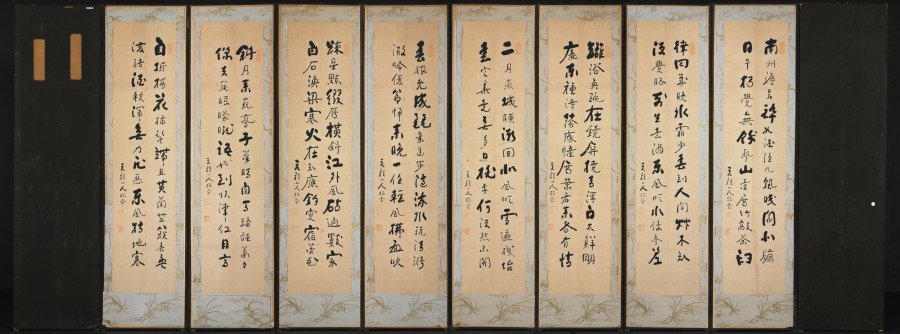
The front of this screen features an assortment of subjects: birds and flowers, landscapes, and scenes of everyday life, mostly in monochromatic ink with light colors. The screen’s reverse side conveys a number of classical poems about the fleeting beauty of the four seasons. Traditionally, only one side of a folding screen bears painted or embroidered images, since these were used as a background furnishing. In Korean houses by the 1800s and early 1900s, however, two-sided folding screens became noticeably popular, possibly inspired by Japanese double-sided folding screens, which mainly served as room dividers in Japanese households.
0 observed sales · 0 comparable sales · 3 structured provenance events · 2 structured exhibitions.

