Grandma Moses at Crystal Bridges: Nostalgia, Commerce and a Modern Construct
A landmark survey at Crystal Bridges revisits Grandma Moses across 80 works and asks whether her timeless rural scenes were a rebuke to modernity or a product of it.
The opening room of Grandma Moses's landmark survey at Crystal Bridges Museum of American Art in Arkansas begins with fire. A bridge burning in Troy glows in red and orange, and Fire in the Woods (1940) crackles with flame and smoke. The emphasis on fire, thunderstorms and extreme weather reads as an anticipatory answer to anyone expecting relentless good cheer.
A Life of Work, Rendered Patiently
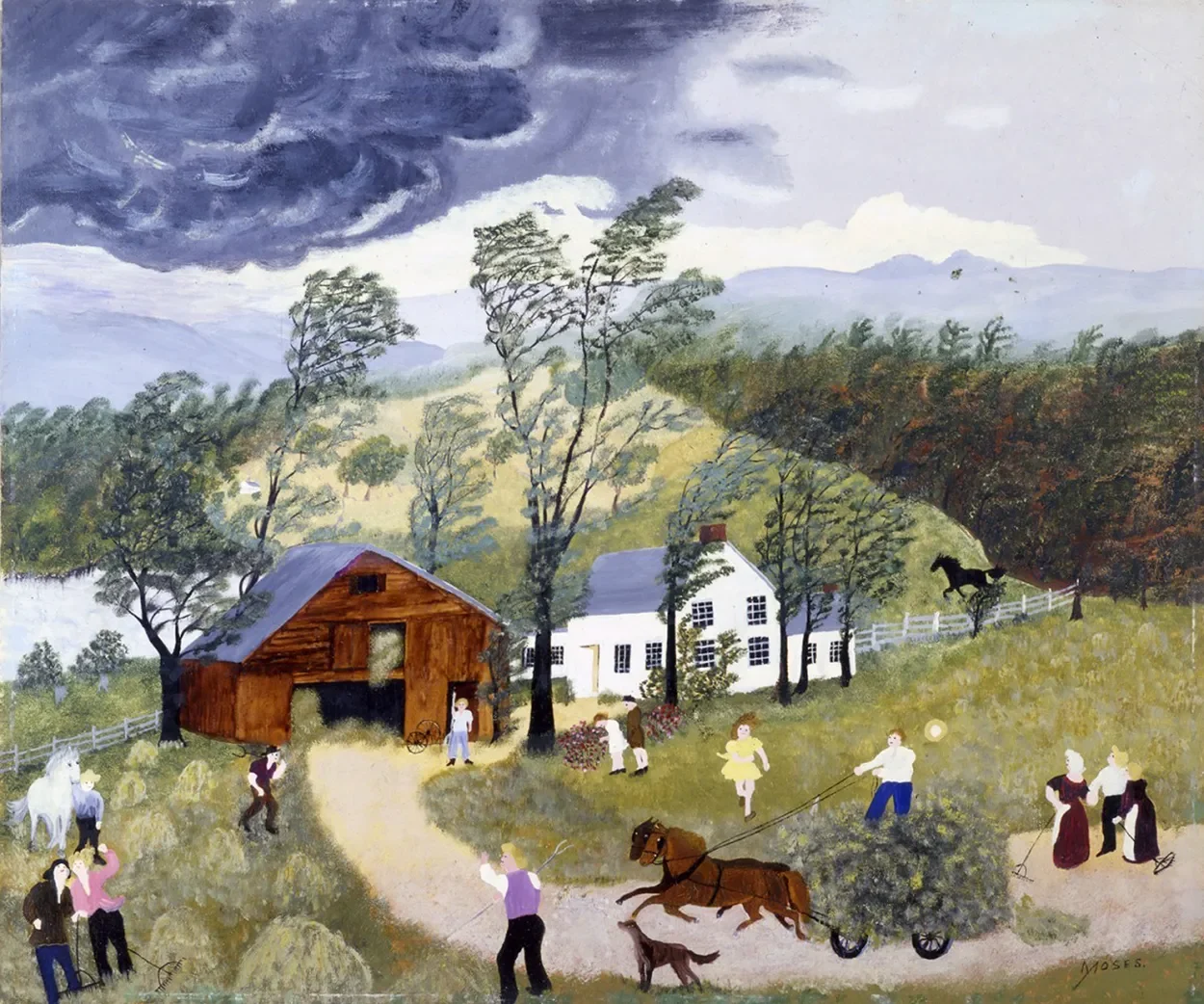
Moses, born Anna Mary Robertson, spent her life on farms in New York state and Virginia's Shenandoah Valley. She lost five of her 10 children in infancy, yet most paintings in the show are happy scenes of work, celebration and family. Cambridge Valley (1942) surveys the New York countryside with topographic attention and almost no loss of detail, the product of unhurried care. People appear in nearly all her works, simply drawn, adding humor: in The Thunderstorm (1948), a man's hat is blown off, a perfect "O" against the picture plane.
The exhibition argues Moses was making art her whole life. A fireboard from 1918 was what she called her first "large picture," and yarn pictures from the 1930s show her command of a limited palette of solid colors. These craft activities, usually kept apart from serious art, gave her a way into visual representation and into telling her own story.
A Century Running Parallel
Her life spanned 101 years, from 1860 to 1961, running alongside a century of rapid industrial transformation. The roughly 80 works in the show have more similarities than differences, suggesting an indifference to the revolutions around her. The catalog instead argues she was in dialog with changing notions of the elderly, the representation of labor in 20th-century art, and Cold War politics that sought to export a vision of American goodness.
The exhibition frames Moses's apparently timeless views as entangled with the modern forces she is often read as resisting.
While her work avoids direct portrayals of industry, she reportedly solved the compositional problem of capturing sprawling valleys after glimpsing a reflection in a hubcap, bringing the gleam of the automobile into scenes that feel entirely timeless. Contemporaries held her up as an example of the "primitive," exhibiting her as the quaint musings of an aging farmwife. She seemed to give America a soul in a postwar era of big capital.
Capital and the Construct of Nostalgia
Yet Moses amassed considerable capital herself, through lucrative partnerships with Hallmark among other companies. She was media-savvy, appearing on talk shows and in documentaries, leveraging the perceived powerlessness of a little old woman to charm and disarm critics. Even her snow scenes are made to sparkle through her use of glitter, a new technology she applied amply against her dealer's advice.
The show's central question is whether Moses was a foil to modernity or a product of it. In the end, there may be nothing more modern than nostalgia for the lost authenticity of the countryside, an authenticity Moses returns viewers to in her sincerely merry paintings.