Comparable Sales
Same-artist public sales ranked by medium, creation year, dimensions and sale recency.
No public-rights comparable sales meet the current evidence criteria. RELICT does not fill the table with research-only or licensed-only facts.
Observed sale facts, comparable evidence, artist index history and modeled research remain separate.
Same-artist public sales ranked by medium, creation year, dimensions and sale recency.
(Nathan Chaikin, Switzerland, sold to Mr. and Mrs. Kelvin Smith)
The Kelvin Smith Collection, Cleveland, OH, given by Mrs. Kelvin [Eleanor Armstrong] Smith [1899–199...
The Cleveland Museum of Art, Cleveland, OH
(Nathan Chaikin, Switzerland, sold to Mr. and Mrs. Kelvin Smith) The Kelvin Smith Collection, Cleveland, OH, given by Mrs. Kelvin [Eleanor Armstrong] Smith [1899–1998] to the Cleveland Museum of Art The Cleveland Museum of Art, Cleveland, OH
Ukiyo-e: Floating World. The Cleveland Museum of Art, Cleveland, OH (June 11-September 2, 1973). A Private World: Japanese and Chinese Art from the Kelvin Smith Collection. The Cleveland Museum of Art, Cleveland, OH (organizer) (September 14-November 13, 1988). Japan’s Floating World 日本の浮世. The Cleveland Museum of Art (organizer) (April 8-October 9, 2022).
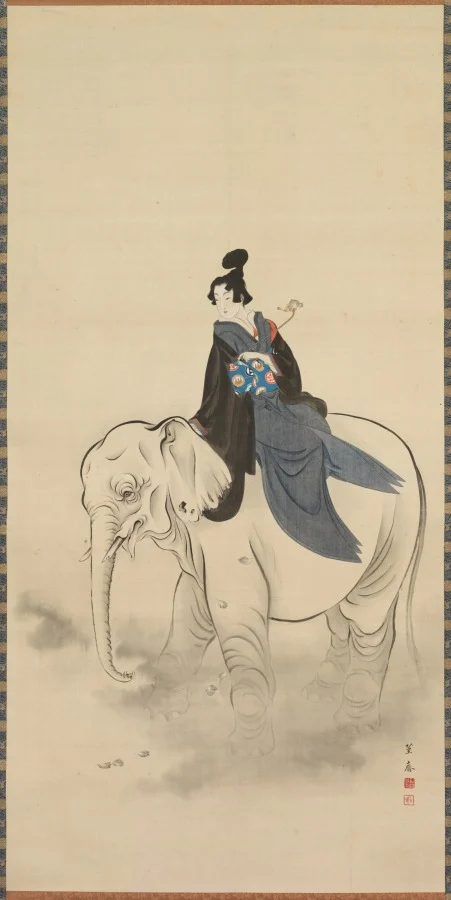
Here, a woman dressed as a man replaces Fugen, a bodhisattva—a being among those considered enlightened in Buddhism—who symbolizes learning as a path to awakening and typically rides an elephant. The painting teaches the lesson of impermanence through the petals falling from the lotus flower the woman holds. It also alludes to the legend of Eguchi, a 12th-century courtesan who, following an encounter with a Buddhist monk-poet called Saigyō, revealed herself to be a manifestation of Fugen.
Observed sales: 0 · Comparable Sales: 0 · Provenance: 3 · Exhibitions: 3.