Comparable Sales
Same-artist public sales ranked by medium, creation year, dimensions and sale recency.
No public-rights comparable sales meet the current evidence criteria. RELICT does not fill the table with research-only or licensed-only facts.
Observed sale facts, comparable evidence, artist index history and modeled research remain separate.
Same-artist public sales ranked by medium, creation year, dimensions and sale recency.
By 1946 Italico Brass (Venice, Italy)
Alessandro Brass (Venice, Italy), sold to the Cleveland Museum of Art, 1947.
By 1946 Italico Brass (Venice, Italy) Alessandro Brass (Venice, Italy), sold to the Cleveland Museum of Art, 1947.
The Venetian Tradition. The Cleveland Museum of Art, Cleveland, OH (November 8, 1956-January 1, 1957). Renaissance to Runway: The Enduring Italian Houses. The Cleveland Museum of Art, Cleveland, OH (organizer) (November 9, 2025-February 1, 2026). CMA, 1956: "The Venetian Tradition," cat. by Henry S. Francis, cat. no. 55 (Note: the second part of the inscription given in the catalogue is non-existent).
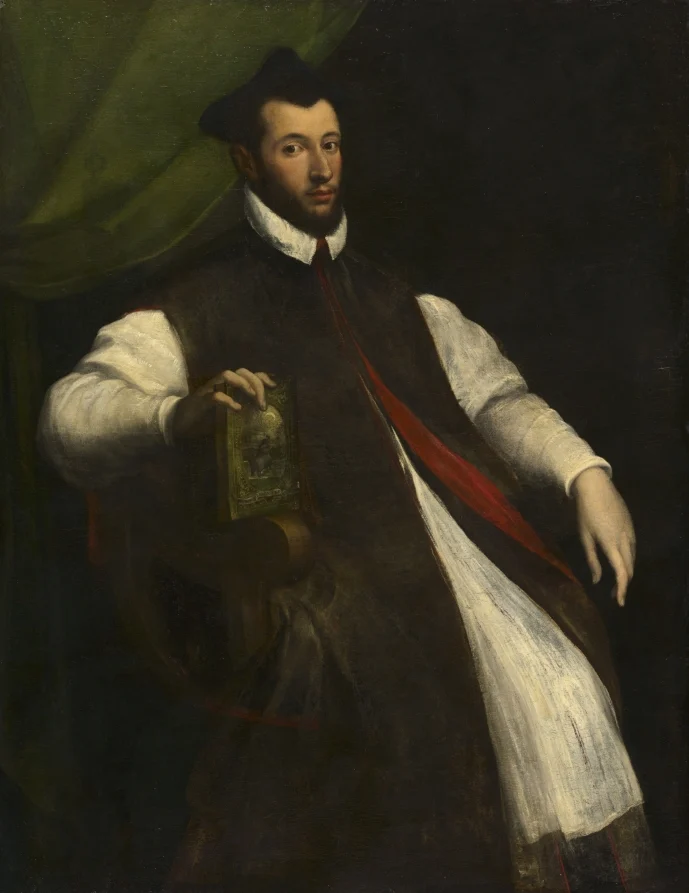
Girolamo da Carpi, a court artist from Ferrara, was influenced by the grace and intellectual artificiality found in Italian Mannerist art, seen in the flowing S-curve of the sitter's clothing and his delicate and attenuated fingers. The sitter's dress identifies him as a prelate, a high-ranking member of the Catholic clergy. His costume includes a dark mantel with red lining over a gauzy, white <em>rochet</em> and the three-cornered hat, called a<em> biretta</em>. In his right hand he holds a book whose cover displays an elephant, standing in water, looking at the moon. This motif symbolized purity, and the sitter's virtue is further emphasized through the book's inscription, MUNDOS LIBENTER ASPICIT, which means, "The moon beholds the pure with pleasure." While several noble Renaissance households used this design for their family emblems, none have yet proven related to the prelate in this painting and so his identity remains unknown.
0 observed sales · 0 comparable sales · 2 structured provenance events · 2 structured exhibitions.