可比销售
同一艺术家的公开销售,按媒介、创作年份、尺寸和销售新近程度排序。
没有具有公开使用权的可比销售符合当前证据标准。RELICT 不会用仅供研究或仅限许可访问的数据填充表格。
实际销售事实、可比证据、艺术家指数历史与模型研究保持分开。
同一艺术家的公开销售,按媒介、创作年份、尺寸和销售新近程度排序。
(Kochukyo Co., Inc., Tokyo, Japan, sold to the Cleveland Museum of Art)
The Cleveland Museum of Art, Cleveland, OH
(Kochukyo Co., Inc., Tokyo, Japan, sold to the Cleveland Museum of Art) The Cleveland Museum of Art, Cleveland, OH
Year in Review: 1979. The Cleveland Museum of Art (organizer) (February 13-March 9, 1980). Byobu: The Art of the Japanese Screen. The Cleveland Museum of Art (organizer) (August 1-October 14, 1984). Byobu: The Art of the Japanese Screen. The Cleveland Museum of Art, Cleveland, OH (organizer) (December 8, 1987-January 10, 1988). Highlights of Asian Paintings from The Cleveland Museum of Art. Nara National Museum (organizer) (February 21-March 29, 1998); Suntory Museum of Art (April 28-June 21, 1998). Admired from Afar: Masterworks of Japanese Painting from the Cleveland Museum of Art. Tokyo National Museum, Tokyo, Japan (January 15-February 23, 2014). Practice and Play in Japanese Art. The Cleveland Museum of Art, Cleveland, OH (organizer) (June 20-November 30, 2025).
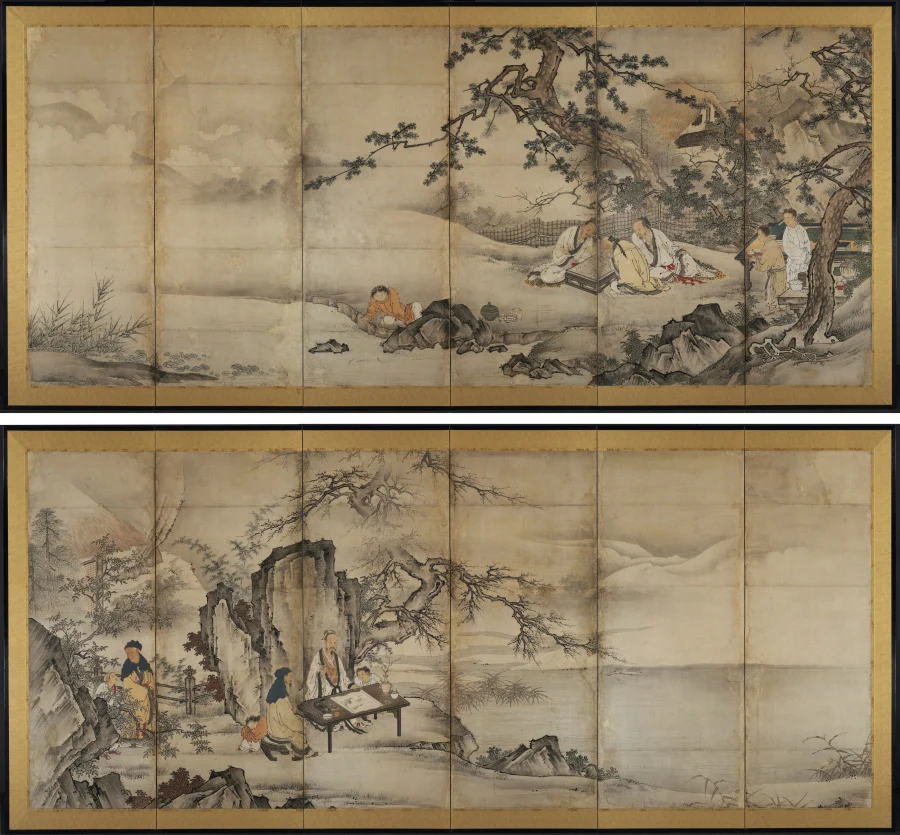
This pair of screens shows a group of elite Chinese gentlemen and their servants in the countryside. One man is considering his painting in progress, while another looks on as two of his companions play a board game called <em>qi</em>, known in Japan as Go. Nearby is a table set with a selection of books ready to be read and a <em>qin</em>, a type of stringed instrument, still wrapped in its cloth case waiting to be played. The mood is one of enjoyment balanced with formality. Historically, playing the qin and qi along with practicing or admiring calligraphy and painting were considered four skills essential for cultured men in China.
观察到的销售: 0 · 可比销售: 0 · 来源与流传记录: 2 · 展览: 6.