Family Boards Are Young but Not Yet Strong, Governance Survey Finds
A survey of 260 family business shareholders, directors, executives and advisors finds boards usually outlast management scrutiny but lag on succession. Independent directors and compound governance practices separate effective boards from the rest.
A Board Older Than Its Own Structure
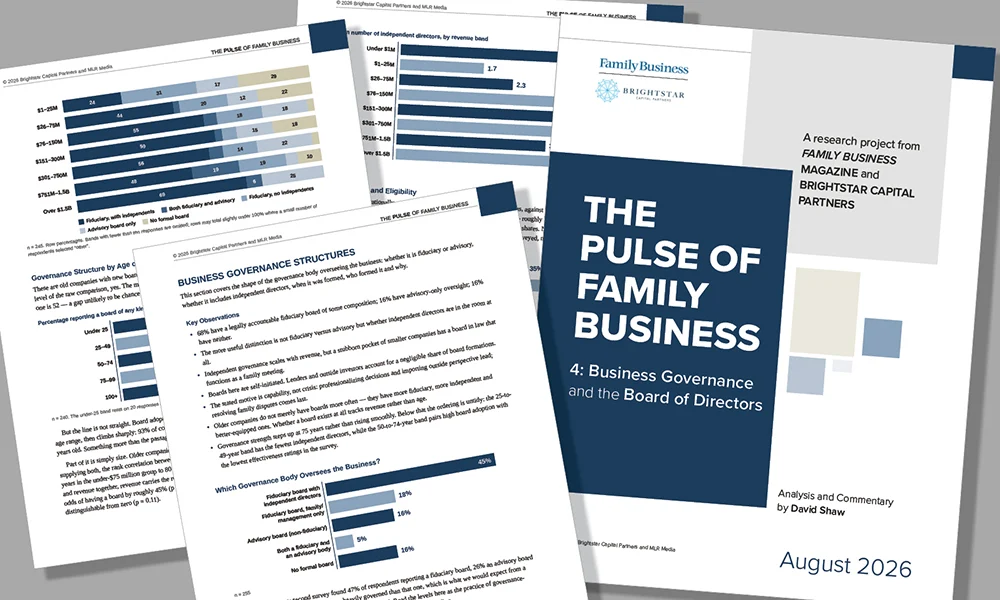
The fourth part of The Pulse of Family Business survey series turns from how families organise themselves to the body that holds management accountable: the board of directors. It draws on 260 responses from family shareholders, directors, executives and advisors, and it arrives with an awkward chronology. The median company in the sample is 70 years old; the median board dates from 2014. Nearly half of all current structures were established since 2015.
Governance, in other words, is a recent invention inside firms that have been trading for generations. The survey frames that gap as one of the recurring questions facing multi-generational businesses alongside family engagement and succession.
Independence Is the Dividing Line
The sharpest result concerns who sits in the room. Where a fiduciary board includes independent directors, 73.5% of respondents rate it effective or highly effective. Where the fiduciary board is composed entirely of family and management, that figure falls to 37.9%.
Boards using two or fewer of seven standard practices rate 32.4% effective; those using six or seven rate 73.1%.
Advisory-only boards occupy the weakest position of any structure that has a board at all, with just 32.3% rating them effective.
Succession Remains the Weakest Function
Of ten board responsibilities rated, succession planning and supporting the family through transitions rank last. Roughly half of respondents consider their board effective at either. The finding sits uncomfortably beside the survey series' broader observation that succession challenges recur among the issues family businesses report most often.
Self-evaluation is narrower still. Only 43% of boards conduct a formal annual self-evaluation, making it the least adopted governance practice the survey tested.
Where the CEO Still Decides
The board decides on CEO evaluation in 69% of cases. Employment of family members is different: the CEO decides in 37% of cases and the board in only 24%. Ownership of the two decisions does not move in step.
Age Shapes the Board, Not Its Existence
Company age predicts the kind of board — fiduciary, independent, committee-equipped — far more than whether one exists at all. Board presence tracks revenue rather than age. The step change comes at 75 years, and boards do not improve with age; older companies simply have better ones.
Practices Compound
Boards using two or fewer of seven standard practices rate 32.4% effective. Those using six or seven rate 73.1%. The survey also repeats a finding from its succession edition: use of a family business consultant showed no measurable effect on how effective respondents judged their board to be.
What the Numbers Do Not Say
The survey does not claim that independent directors cause effectiveness, nor that older companies are better governed by default. It reports what respondents say about the structures they sit in. What it does establish is a floor: below a certain density of practices, a board is unlikely to be judged effective at all.