Tiger
The Cleveland Museum of Art · Purchase from the J. H. Wade Fund
Museum

Tiger

c. 1250–79
Fachang Muqi (Chinese, 1220–1280) visual detail
ArtisteFachang Muqi (Chinese, 1220–1280)
Voir l’artiste →

Analyse de marché

Les ventes observées, preuves comparables, historiques d’indice et recherches modélisées restent distincts.

Preuves publiques
Dernier prix connu—0 matched observed sales
Médiane observée—
Ventes observées0
Indice d’artiste—
Aucune vente observée normalisée aux droits vérifiés n’est liée à cette œuvre. Aucun historique de prix artificiel n’est affiché.
Indice d’artiste indisponibleAucun calcul public d’indice d’artiste terminé.Le contexte d’un artiste n’est pas une estimation d’œuvre.

Ventes comparables

Ventes publiques du même artiste classées par technique, année de création, dimensions et date de vente.

Classé selon les preuves
Aucune vente comparable aux droits publics ne satisfait les critères actuels. RELICT ne remplit pas le tableau avec des faits réservés à la recherche ou sous licence uniquement.

Provenance

Public
Provenance

Ashikaga Yoshimitsu 足利義滿 [1358–1408]

1400s

Ashikaga Yoshinori 足利義教 [1394–1441] or Ashikawa Yoshimasa 足利義政 [1436–1490] (Zakka shitsu yin...

1600s

Tokugawa Iemitsu 德川家光 [1604–1651]

Provenance

Viscount Sakai 子爵 酒井氏 [late 1800s–early 1900s]

?–1958

(Howard Hollis and Company, Cleveland, OH, sold to the Cleveland Museum of Art)

1958–

The Cleveland Museum of Art, Cleveland, OH

Texte de provenance source

Ashikaga Yoshimitsu 足利義滿 [1358–1408] Ashikaga Yoshinori 足利義教 [1394–1441] or Ashikawa Yoshimasa 足利義政 [1436–1490] (Zakka shitsu yin 雜華室印) Tokugawa Iemitsu 德川家光 [1604–1651] Viscount Sakai 子爵 酒井氏 [late 1800s–early 1900s] (Howard Hollis and Company, Cleveland, OH, sold to the Cleveland Museum of Art) The Cleveland Museum of Art, Cleveland, OH

The Cleveland Museum of ArtFiabilité 100%

Expositions

Public
Texte d’exposition source

1000 Jahre Chinesische Malerei. Haus der Kunst, Munich, Mùnich, Germany (organizer) (October 16-December 13, 1959). Chinese Art. Smith College Museum of Art, Northampton, MA (organizer) (January 8-26, 1962). The Art of Southern Sung China. The Asia Society Museum, New York, NY (organizer) (February 15-April 15, 1962). The Colors of Ink. Asia House Galleries (January 10-March 3, 1974); The Cleveland Museum of Art, Cleveland, OH (organizer) (April 9-May 12, 1974). Eight Dynasties of Chinese Painting. The Nelson-Atkins Museum of Art (November 7, 1980-January 4, 1981); The Cleveland Museum of Art (February 11-March 29, 1981); Tokyo National Museum (October 4-November 17, 1982). Roaring Tigers and Leaping Carp: Decoding the Symbolic Language of Chinese Animal Painting. The Cincinnati Art Museum, Cincinnati, OH (organizer) (October 9, 2009-January 3, 2010). Six Dynasties of Chinese Painting (Chinese art rotation). The Cleveland Museum of Art, Cleveland, OH (organizer) (November 10, 2023-May 5, 2024). Six Dynasties of Chinese Painting Part 2. The Cleveland Museum of Art, Cleveland, OH (organizer) (May 10-September 1, 2024). Chinese Paintings. The Cleveland Museum of Art, Cleveland, OH (July 19-August 7, 1960). Japanese Decorative Style. Cleveland Museum of Art, Cleveland, OH (August 30-October 15, 1961) Southern Sung. Asia House Gallery, New York, NY, (1967?). Cahill, cat. no. 28. Main Asian Rotation (Gallery 119). The Cleveland Museum of Art, Cleveland, OH (March 12-July 16, 2003).

The Cleveland Museum of ArtFiabilité 100%
Vue d’ensemble sourcée Éléments probants

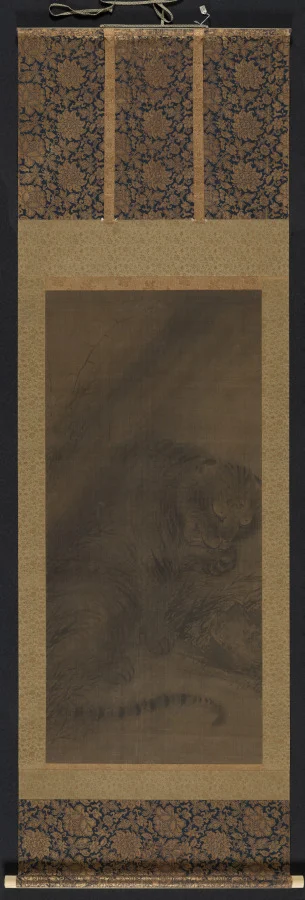
The dragon and tiger are tied to the philosophical concept of yin and yang, which describes opposite but complementary forces. The dragon occupies a tiered background of waves and mist. Its luminous head emerges from the darker passages, and its narrow twisting body is serpent-like. By contrast, the close-up view of the tiger emphasizes its bulk. The tiger bends its head to lick its paw while its tail curls in the foreground. <br><br>In their original Chan Buddhist context, this pair of scrolls likely flanked a central image, like the Bodhisattva Guanyin. The silk has darkened over the centuries, and the slight reddish shading in the tiger’s tongue and nose has faded.

The Cleveland Museum of ArtFiabilité 100%

État des preuves

Ventes observées: 0 · Ventes comparables: 0 · Provenance: 6 · Expositions: 8.

Place Of OriginShort DescriptionProvenance TextExhibition HistoryCredit Line