Ventas comparables
Ventas públicas del mismo artista ordenadas por técnica, año de creación, dimensiones y antigüedad de venta.
Los hechos de ventas observadas, pruebas comparables, historial del índice y estudios modelados permanecen separados.
Ventas públicas del mismo artista ordenadas por técnica, año de creación, dimensiones y antigüedad de venta.
Murado Torujiro, Ōtsu, Japan
(Nisaburo Mizutani, Kyoto, Japan, sold to the Cleveland Museum of Art)
The Cleveland Museum of Art, Cleveland, OH
Murado Torujiro, Ōtsu, Japan (Nisaburo Mizutani, Kyoto, Japan, sold to the Cleveland Museum of Art) The Cleveland Museum of Art, Cleveland, OH
Year in Review: 1971. The Cleveland Museum of Art, Cleveland, OH (organizer) (December 28, 1971-February 6, 1972). A Cleveland Bestiary. The Cleveland Museum of Art, Cleveland, OH (organizer) (October 15-December 16, 1981). Suibokuga: Japanese Ink Painting. The Cleveland Museum of Art, Cleveland, OH (organizer) (October 1, 1985-February 24, 1986). Byobu: The Art of the Japanese Screen. The Cleveland Museum of Art, Cleveland, OH (organizer) (December 8, 1987-January 10, 1988). Asian Autumn: Splendid Variety: 18th-Century Art in Japan. The Cleveland Museum of Art, Cleveland, OH (organizer) (November 16, 1993-March 6, 1994). Unfolding Beauty: Japanese Screens from the Cleveland Museum of Art. The Cleveland Museum of Art, Cleveland, OH (organizer) (July 15-September 16, 2001). Main Asian Rotation (Gallery 121). The Cleveland Museum of Art, Cleveland, OH (July 18-October 26, 2003).
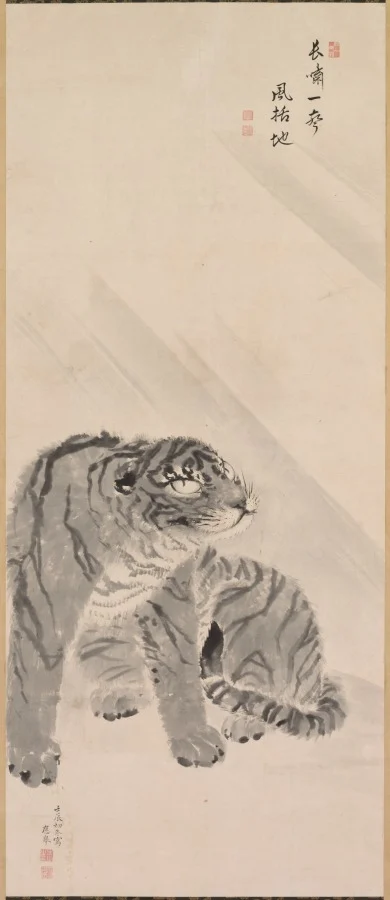
The seals appended to the inscription on this painting suggest that the text was brushed by Yūjō (1723–1773), an imperial prince who became a Buddhist monk and was abbot of Enman'in at Miidera. The line is from a poem attributed to a Yuan dynasty poet, Yu Ruyu (dates unknown), and describes the sound of a fierce wind lashing the ground. Wind is associated with the roar of the tiger. Yūjō was Maruyama Ōkyo's most important patron as a young artist, and this painting has a signature asserting that Ōkyo created it in 1772, the year before Yūjō's death. While Yūjō produced a preface for a now famous set of handscrolls he commissioned Ōkyo to paint, and a number of Ōkyo's compositions for Enman'in survive, this work would appear to be one imagining their relationship, as opposed to a genuine piece.
Ventas observadas: 0 · Ventas comparables: 0 · Procedencia: 3 · Exposiciones: 6.