Retour
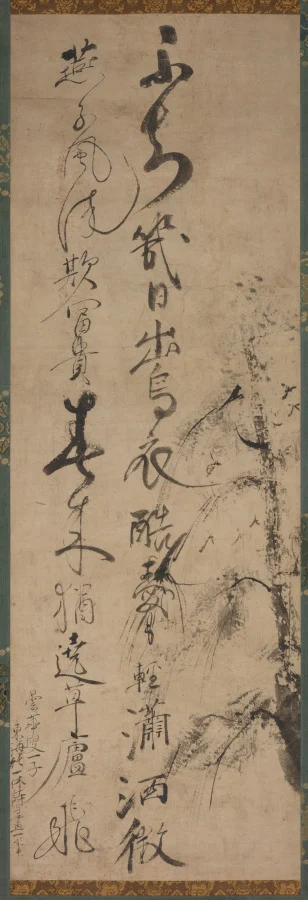
Calligraphy with Willow and Swallows
The Cleveland Museum of Art · Gift from the Collection of George Gund III
Museum

Calligraphy with Willow and Swallows

1400s
Ikkyū Sōjun (Japanese, 1394–1481) visual detail
ArtisteIkkyū Sōjun (Japanese, 1394–1481)
Voir l’artiste →

Analyse de marché

Les ventes observées, preuves comparables, historiques d’indice et recherches modélisées restent distincts.

Preuves publiques
Dernier prix connu—0 matched observed sales
Médiane observée—
Ventes observées0
Indice d’artiste—
Aucune vente observée normalisée aux droits vérifiés n’est liée à cette œuvre. Aucun historique de prix artificiel n’est affiché.
Indice d’artiste indisponibleAucun calcul public d’indice d’artiste terminé.Le contexte d’un artiste n’est pas une estimation d’œuvre.

Ventes comparables

Ventes publiques du même artiste classées par technique, année de création, dimensions et date de vente.

Classé selon les preuves
Aucune vente comparable aux droits publics ne satisfait les critères actuels. RELICT ne remplit pas le tableau avec des faits réservés à la recherche ou sous licence uniquement.

Provenance

Public
?-2015

George Gund III [1937-2013], bequest to the Cleveland Museum of Art

2015-

The Cleveland Museum of Art, Cleveland, OH

Texte de provenance source

George Gund III [1937-2013], bequest to the Cleveland Museum of Art The Cleveland Museum of Art, Cleveland, OH

The Cleveland Museum of ArtFiabilité 100%

Expositions

Public
Texte d’exposition source

Ink Paintings and Ash-Glazed Ceramics: Medieval Calligraphy, Painting, and Ceramic Art from Japan and Korea. The Cleveland Museum of Art, Cleveland, OH (organizer) (March 19-May 28, 2000). Japanese Gallery 235 Rotation. The Cleveland Museum of Art (organizer) (January 2-July 9, 2018).

The Cleveland Museum of ArtFiabilité 100%

Vue d’ensemble sourcée Éléments probants

The famed Buddhist monk Ikkyū is best remembered for his calligraphy. Calligraphic conventions of his time called for brushwork that did not vary much in style from character to character. However, as Ikkyū’s lines progress, his brushwork wanders between standard script and a sort of shorthand, marked by an uneven distribution of ink and a reduction of the characters to only the most necessary strokes. Ikkyū’s direct communication of emotion via brushwork became characteristic of the works produced by monks affiliated with the temple Daitokuji later in the Edo period (1615–1868).

The Cleveland Museum of ArtFiabilité 100%

État des preuves

Ventes observées: 0 · Ventes comparables: 0 · Provenance: 2 · Expositions: 2.

Place Of OriginShort DescriptionProvenance TextExhibition HistoryCredit Line