Ventes comparables
Ventes publiques du même artiste classées par technique, année de création, dimensions et date de vente.
Les ventes observées, preuves comparables, historiques d’indice et recherches modélisées restent distincts.
Ventes publiques du même artiste classées par technique, année de création, dimensions et date de vente.
Ogiware Yasunosuke
Nagami Takutaro 永見 徳太郎 [1890–1950], Nagasaki, Japan
(Mayuyama and Company, Tokyo, Japan, sold to the Cleveland Museum of Art)
The Cleveland Museum of Art, Cleveland, OH
Ogiware Yasunosuke Nagami Takutaro 永見 徳太郎 [1890–1950], Nagasaki, Japan (Mayuyama and Company, Tokyo, Japan, sold to the Cleveland Museum of Art) The Cleveland Museum of Art, Cleveland, OH
Year in Review - Nineteen Hundred Sixty. The Cleveland Museum of Art, Cleveland, OH (organizer) (November 30, 1960-January 1, 1961). Japanese Decorative Style. The Cleveland Museum of Art (August 30-October 15, 1961); The Art Institute of Chicago, Chicago, IL (November 9-December 17, 1961). Japanese Screens from the Museum and Cleveland Collections. The Cleveland Museum of Art, Cleveland, OH (organizer) (March 23-May 8, 1977). Autumn Grasses: Arts of the Momoyama Period (1573-1615). The Cleveland Museum of Art, Cleveland, OH (organizer) (October 4-December 11, 1988). Restoration at Tokyo National Research Institute of Cultural Properties. Tokyo National Research Institute of Cultural Properties (organizer) (May 22, 1997-April 28, 1998). Unfolding Beauty: Japanese Screens from the Cleveland Museum of Art. The Cleveland Museum of Art, Cleveland, OH (organizer) (July 15-September 16, 2001). Highlights of Japanese Art. The Cleveland Museum of Art, Cleveland, OH (organizer) (December 7, 2025-June 14, 2026). Main Japanese Rotation (Gallery 237). The Cleveland Museum of Art, Cleveland, OH (May 29-December 23, 2013).
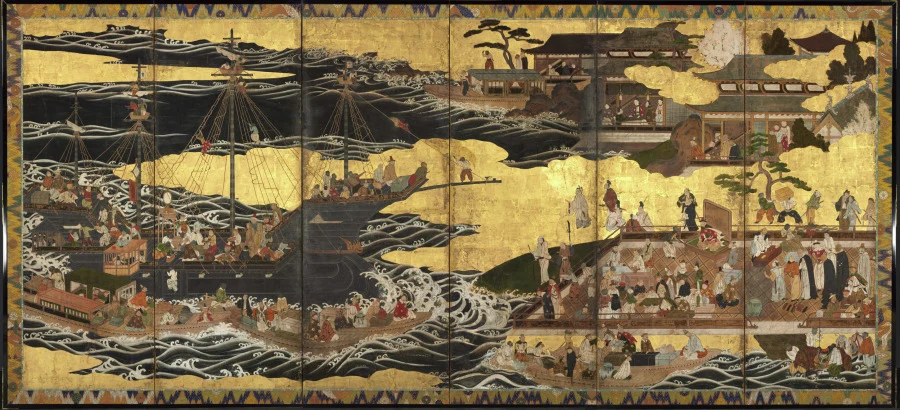
This screen and its corresponding screen show Portuguese merchants arriving in Japan, having crossed the oceans in their large ship with a multinational crew. The Portuguese were known in Japan as the “Southern Barbarians” because they arrived from the south and their customs and manners were unfamiliar to the Japanese, who had not encountered anyone from Europe until their first appearance in 1543. In 1639, the Portuguese were forced out of Japan, mainly owing to internal difficulties caused by their Catholic missionaries, but they were a major conduit for both objects and ideas from Europe for nearly 100 years.
Ventes observées: 0 · Ventes comparables: 0 · Provenance: 4 · Expositions: 7.