Comparable Sales
Same-artist public sales ranked by medium, creation year, dimensions and sale recency.
No public-rights comparable sales meet the current evidence criteria. RELICT does not fill the table with research-only or licensed-only facts.
Observed sale facts, comparable evidence, artist index history and modeled research remain separate.
Same-artist public sales ranked by medium, creation year, dimensions and sale recency.
Royal Library of Mandi, India, sold to a German private collector
A German private collection
Nancy and Wayne Hunnicutt, California, given to the Cleveland Museum of Art
The Cleveland Museum of Art, Cleveland, OH
Royal Library of Mandi, India, sold to a German private collector A German private collection Nancy and Wayne Hunnicutt, California, given to the Cleveland Museum of Art The Cleveland Museum of Art, Cleveland, OH
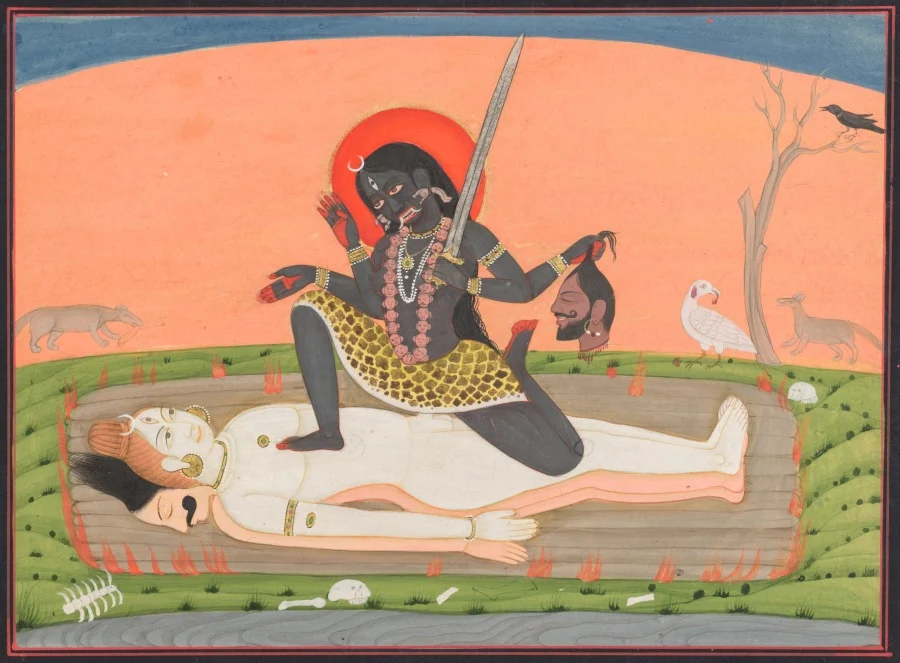
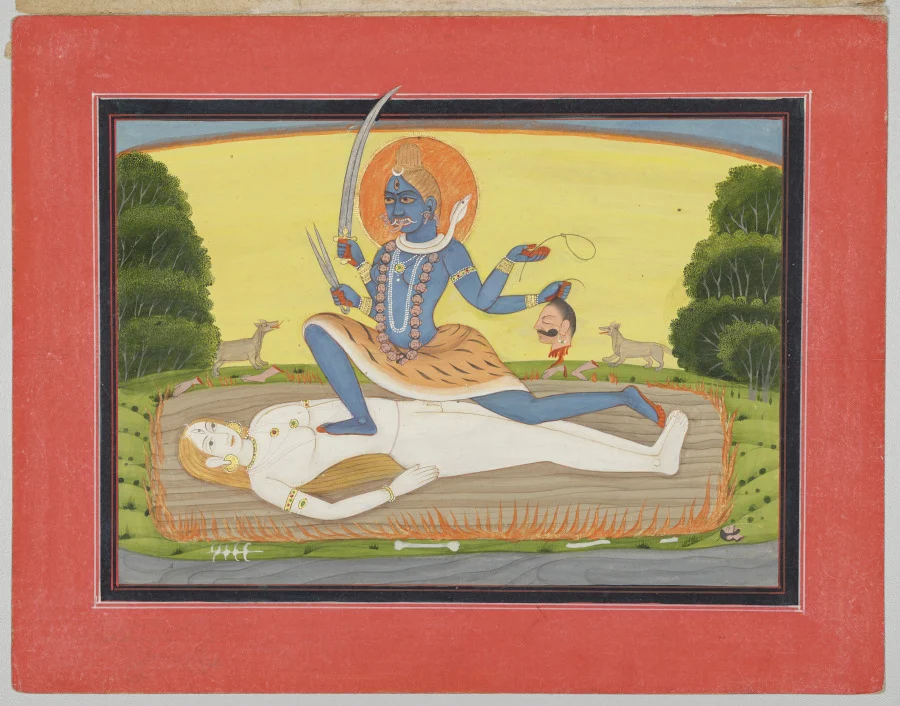
Showing her utter superiority over the male god, the blue-skinned goddess, Devi, lunges with fangs bared and tongue lolling on the supine body of Shiva, stretched on a burning pyre. In one hand she holds the sword she used to decapitate the demon whose head she triumphantly grasps in her left hand. In the other two hands she holds shears and a noose. Her garment is a tiger skin; her garland consists of severed heads; and her torque is a cobra. As the personification of divine energy—<em>shakti </em>in Sanskrit—Devi appears active, while the male principle, personified as her consort Shiva, is like a corpse (<em>shava</em>). <br> <br> The scene is set in a cremation ground, complete with body parts, jackals, and bones. Contemplation of paintings such as this assists followers in overcoming fear of death. In this image, the dead body is overlaid with the dual principles of the divine in Hindu thought: male and female, passive and active, matter and energy, light and dark, and Shiva and Shakti in the copulative act of generating new creation even in the context of death and dismemberment.
0 observed sales · 0 comparable sales · 4 structured provenance events · 0 structured exhibitions.