Comparable Sales
Same-artist public sales ranked by medium, creation year, dimensions and sale recency.
No public-rights comparable sales meet the current evidence criteria. RELICT does not fill the table with research-only or licensed-only facts.
Observed sale facts, comparable evidence, artist index history and modeled research remain separate.
Same-artist public sales ranked by medium, creation year, dimensions and sale recency.
Qing imperial collection (seals of the Qianlong Emperor, r. 1736–1795)
(David Newman [1936–2012], London, England, sold to the Cleveland Museum of Art)
The Cleveland Museum of Art, Cleveland, OH
Qing imperial collection (seals of the Qianlong Emperor, r. 1736–1795) (David Newman [1936–2012], London, England, sold to the Cleveland Museum of Art) The Cleveland Museum of Art, Cleveland, OH
Year in Review: 1979. The Cleveland Museum of Art (organizer) (February 13-March 9, 1980). Eight Dynasties of Chinese Painting. The Cleveland Museum of Art (February 11-March 29, 1981); Tokyo National Museum (October 4-November 17, 1982). The Twain Shall Meet. The Cleveland Museum of Art, Cleveland, OH (organizer) (October 30, 1985-January 5, 1986). Fans: East and West. The Cleveland Museum of Art, Cleveland, OH (organizer) (December 15, 1992-March 7, 1993). Main Asian Rotation (Gallery 122). The Cleveland Museum of Art, Cleveland, OH (July 23-October 27, 2003).
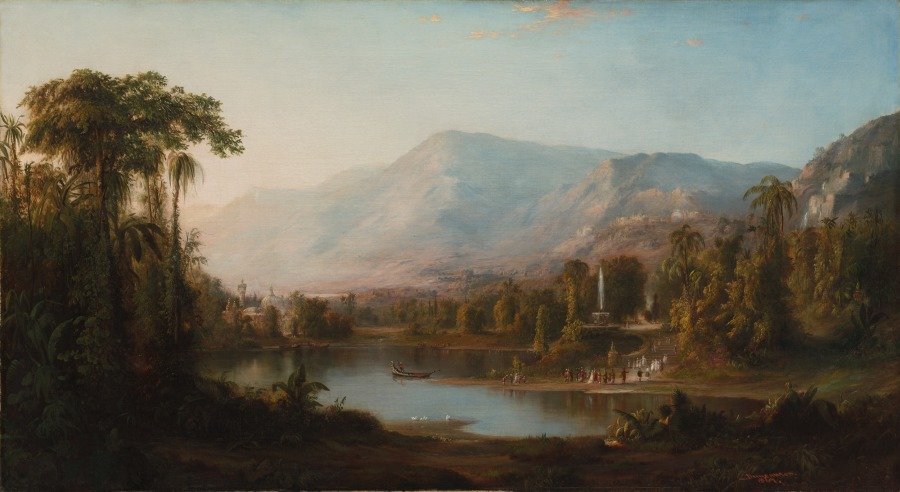
Robert S. Duncanson (American, 1821–1872) · 1867

Yan Hui (Chinese, active 1270–1310) · 1250

Eastman Johnson (American, 1824–1906) · 1872

Rockwell Kent (American, 1882–1971) · 1907

Dong Qichang (Chinese, 1555–1636) · 1624
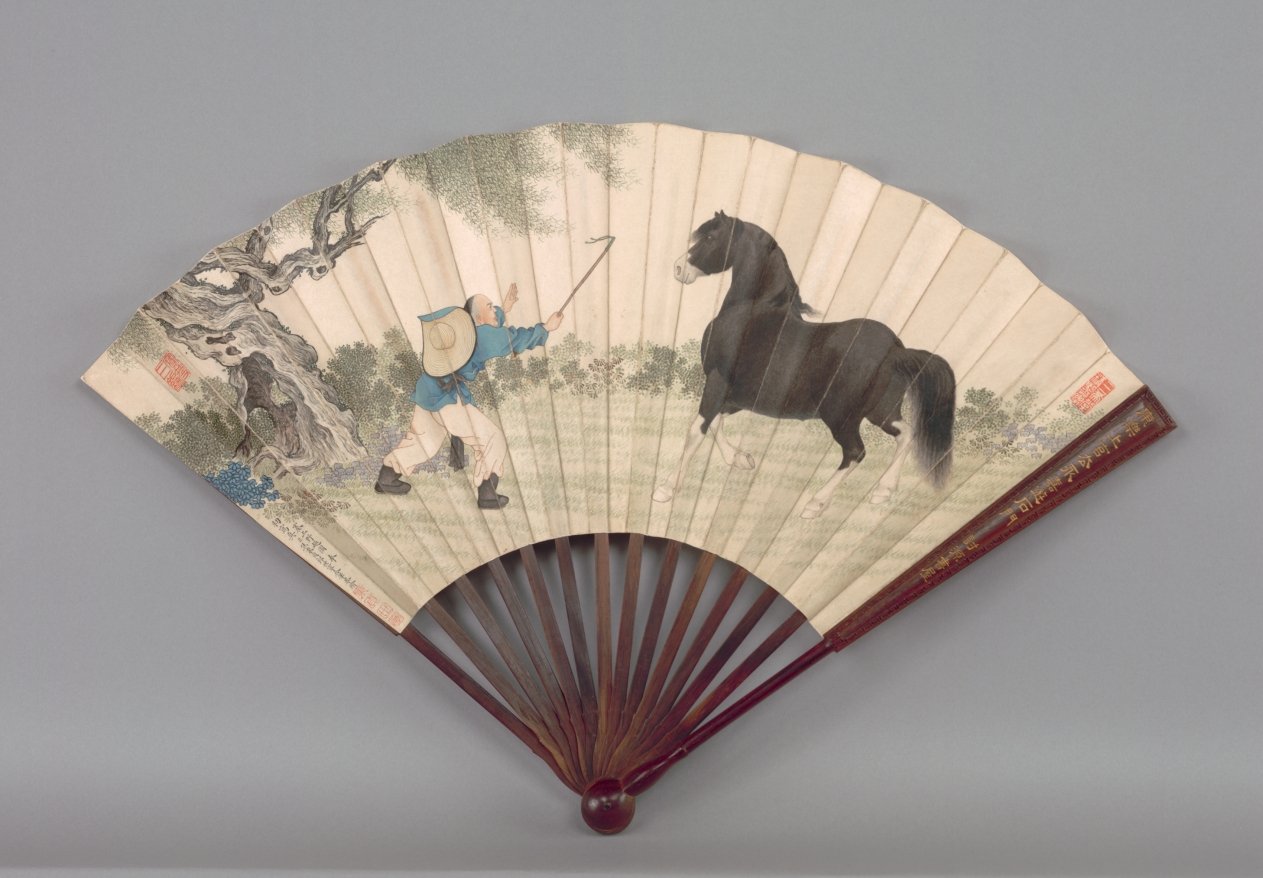
Jiao Bingzhen, a court painter largely active during the reign of the Kangxi Emperor, was the senior artist on this fan. Jiao painted the Manchu horse trainer and the setting into which the horse was inserted by Giuseppe Castiglione. Each artist was bonded to his own artistic tradition, while flexibly and harmoniously accommodating the others’ style. <br><br>Jiao’s brushwork displays rigor and control, particularly in the twisting and turning trunk of the willow. The treatment of the figure and his clothes is an exercise in linearity. The horse trainer’s gesture and posture closely adhere to the known repertoire of the Chinese figural tradition, but the specificity supplies a sense of documentary reportage of life on the frontier. His shaved forehead and white temples identify him as a Manchu. The thick fabric of his garments was defined in a different sort of brush line than Jiao typically used for Chinese scholars or travelers. <br><br>Jesuit priest Castiglione, a newcomer to China at the time this was painted, brought a sense of Western realism to the horse. Poised at a slight angle, the horse is alert, its eye gleaming. Its contours suggest the bulk of its anatomy with skilled but not overpowering modelling, and careful and subtly wrought attention to detail, such as fluttering strand of mane. <br><br>Because of his ability to combine traditional Chinese painting techniques with Western methods of perspective and chiaroscuro, Castiglione went on to be the most favored and honored of the missionary artists who served the early Qing emperors. Throughout his career, in addition to imperial demands for portraits and records of court events, Castiglione continued to paint favored imperial horses. These animal subjects reflect the desire of Kangxi and his successors to celebrate their nomadic origins and to keep alive the martial prowess of the Manchu warriors in their new and sedentary world of conquered China.
0 observed sales · 0 comparable sales · 3 structured provenance events · 4 structured exhibitions.