Rina Banerjee: From Polymer Engineering to Poetic Sculpture
Artist Rina Banerjee discusses her Brooklyn studio, her sculptures' symbolic materials, and recent acquisitions and exhibitions.
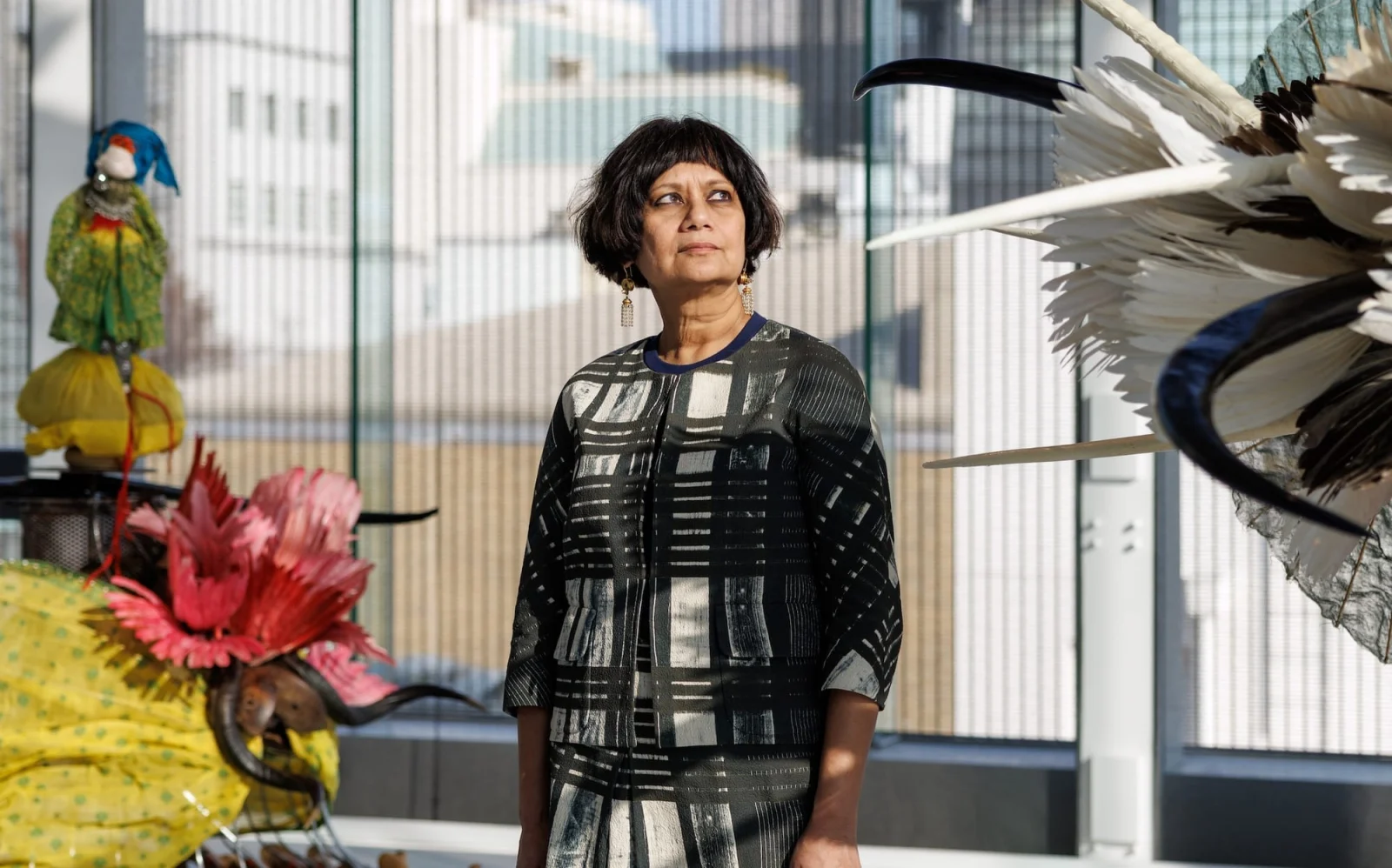
In her new studio in Dumbo, Brooklyn, Rina Banerjee creates works that blur the boundaries between human, animal, and plant life—fingers become tree roots, hair blends with clouds, and interiors emerge. Her sculptures often combine light bulbs, incense, eggs, gourds, feathers, souvenirs, furniture, textiles, cowrie shells, and hair into pieces that float above the ground, giving voice to themes of dislocation and migration. Born in Kolkata in 1963 and raised in London before moving to New York, Banerjee's work reflects a postcolonial perspective, drawing on her family's migrations.
Banerjee's path to art was unconventional: she earned a BS in Polymer Engineering from Case Western Reserve University before pursuing an MFA at the Yale School of Art in 1995. She spoke about how giving up control to paint allows it to become a partner, helping create something beautiful. Her paintings depict watery worlds populated by hybrid figures, their hair or fingernails cascading into tendrils that meld with clouds and atmosphere, evoking the experience of immigrant families and "beauty found amid precarity"—a theme she connects to a recent errand at the Social Security Administration office, where she felt concern for second-language English speakers.
Banerjee acknowledges the women who have advanced her career: Jane Farver included her in the 2000 Whitney Biennial; Courtney Martin curated an early group show at Smack Mellon and recently facilitated the Yale Center for British Art's acquisition of her 2003 monumental sculpture—a Taj Mahal made from a steel-and-copper frame wrapped in pink plastic. Laura Steward Heon curated Yankee Remix at MASS MoCA, and Jodi Throckmorton organized her traveling mid-career survey, Make Me a Summary of the World.
Her work is currently on view in two institutional exhibitions: You made me leave home… at the Louis Vuitton Espace in Tokyo, Japan, and Rina Banerjee: Take me, take me, take me . . . to the Palace of love at the Yale Center for British Art. These presentations highlight her growing institutional presence, from a major British acquisition to a global exhibition at a luxury-brand venue.
Banerjee's influences include artists Richard Mayhew and Santa Barraza, as well as the pantheon of Hindu female deities. Her titles themselves function as poems, each one extending the narrative of her hybrid forms. The artist, who currently lives and works in Brooklyn, continues to challenge viewers with work that resists grounding, offering a vision of radical conjoining between the earth and feminine energy. Her move from polymer engineering to art underscores a deliberate career pivot toward expressive materiality.
Banerjee's 2003 Taj Mahal sculpture now resides in the Yale Center for British Art, marking a key institutional acquisition of her work.