Family Business Survey Turns to Board Governance
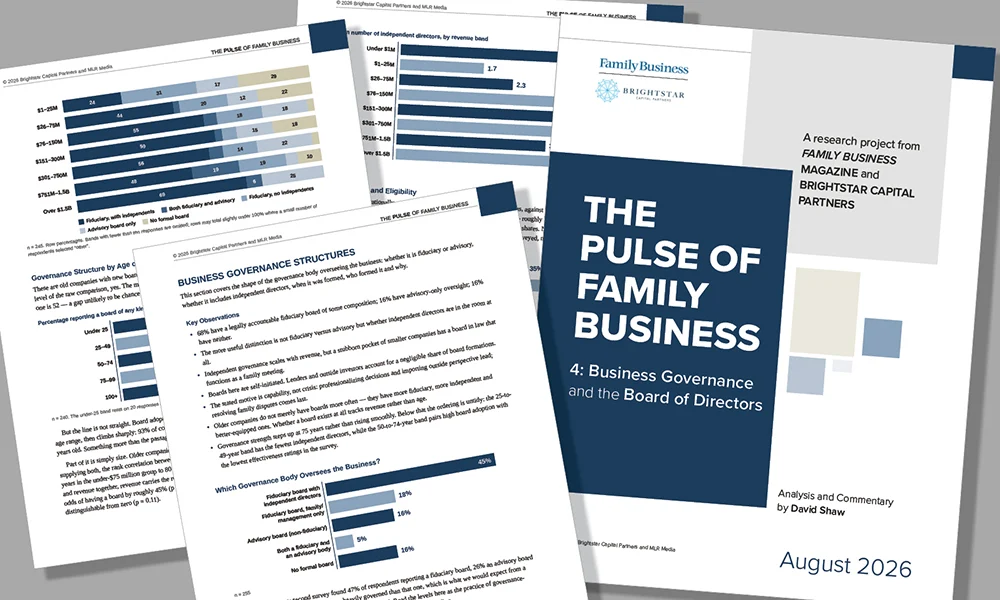
The fourth instalment of the Pulse of Family Business survey series examines the board of directors as the body holding management accountable, drawing on 260 responses from family shareholders, directors, executives and advisors.
A Series Turns to the Boardroom
The Pulse of Family Business Survey Series has reached its fourth report, and with it a shift in focus. Where the third instalment looked at how families organise themselves, this one turns to the governance of the business itself — the board of directors.
The distinction matters. Family organisation concerns the structures a family builds around itself. Board governance concerns the body that holds management accountable. The survey series treats them as separate subjects, each examined in its own report.
What the Report Draws On
The fourth report is built on 260 responses from family shareholders, directors, executives and advisors. That mix places several vantage points inside the same dataset: those who own the business, those who sit on its board, those who run it day to day, and those who advise it.
The report is presented as the latest in a series rather than a standalone study, which situates board governance within an ongoing examination of how family businesses are run and organised.
Why Boards Are the Subject
By framing the board as "the body that holds management accountable," the report signals its central question: how is accountability structured in a family business, and who sits on the other side of the table from management?
The fourth report in the series examines the board of directors, drawing on 260 responses from family shareholders, directors, executives and advisors.
For families with substantial operating businesses, the board is where ownership and management meet. The survey does not, in the material available, disclose its findings on that meeting point — only its scope and its subject.
The Limits of What Is Known
What the material establishes is narrow but clear. There is a series. This is its fourth report. The third looked at family organisation; the fourth looks at the board. It rests on 260 responses across four respondent types. Beyond that, the survey's conclusions are not set out here.
The post is available only to members, a fact that shapes how the material circulates. The underlying data, and any analysis drawn from it, sit behind that boundary.
Governance as a Recurring Theme
The series structure itself is notable. By moving from family organisation to board governance, it treats the family and the business as distinct systems that nonetheless require separate study. Advisors to family enterprises, and the families themselves, are both represented among the respondents.
The report also carries an authorship note: Debbie Davis is identified as the marketing director of Family Business.
What Comes Next
No findings, timelines or subsequent reports are described in the available material. What remains is the framing: a survey series now four reports deep, examining in turn how families organise and how boards hold management to account, on the evidence of 260 respondents.