Colby College Museum Stages "Imagining an Archipelago" Through 2027
A conceptually ambitious exhibition at the Colby College Museum of Art brings together more than 40 contemporary artists and collectives from Cuba, Guam, the Philippines, Puerto Rico and their diasporas, curated by Jessamine Batario.
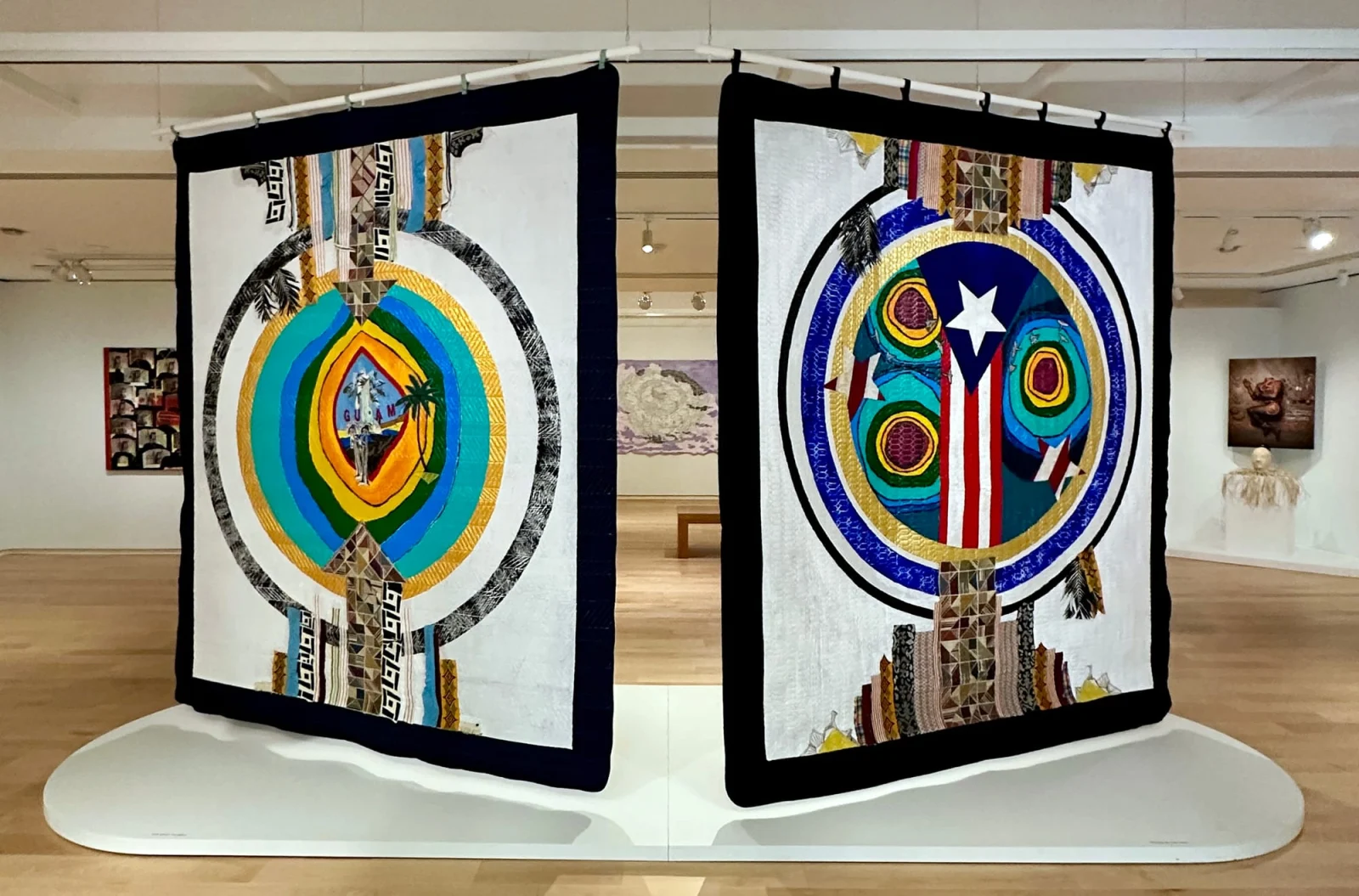
WATERVILLE, Maine — At the Colby College Museum of Art, an exhibition titled Imagining an Archipelago: Art from Cuba, Guam, the Philippines, Puerto Rico, and Their Diasporas assembles work by more than 40 contemporary artists and collectives. The show, curated by Jessamine Batario, runs through June 6, 2027.
The exhibition's organizing conceit is historical. The islands in question were all brought under US control at the end of the War of 1898, handed over by Spain as part of the Treaty of Paris. From that shared, unwilling role in the United States' transformation into a colonial power, the show traces themes of colonization, enslavement, migration and diaspora.
Archipelagic Thinking
Batario takes pains to ensure the places represented are not reduced to an unnuanced sameness. The exhibition is instead an attempt at archipelagic thinking — a concept introduced by Édouard Glissant and expanded upon since — which considers the forms of relation and solidarity made possible by seeing the world from the perspective of archipelagoes: islands that retain their distinctiveness while existing as a collective. The show is divided into two floors, one organized by region, the other by theme.
The entrance sets the terms. A painting by Cuban-born Zilia Sánchez hovers between abstraction, figuration and the cosmological. Félix González-Torres's "Untitled (USA Today)" (1990) lays out candies in red, white and blue wrappers for viewers to consume. A 2023 concrete poem by CHamoru scholar and poet Craig Santos Perez spells out "Archipelagoes resemble constellations." Juana Valdés's photographs "On the Malecón" (2000) document a Havana performance in which she set afloat paper boats made from torn pages of a 19th-century novel.
The show's premise rests on a shared history: all five islands were handed over by Spain to the United States under the Treaty of Paris at the end of the War of 1898.
Labor, Militarism, Food
In the section on the Philippines, migrant labor is central. Wealth sent back by Overseas Filipino Workers, an official designation, accounts for nearly 9% of the country's GDP. Thea Canlas's "Export Quality (Value Studies: Uniforms)" (2023) fashions work uniforms for a factory laborer and a maid from piña cloth, a material usually reserved for finery. Jerome Reyes's newly commissioned projection "Pharos (Covenants)" (2026) speaks to the role Filipino health care workers played during the COVID-19 crisis. Carlos Villa's "Where My Uncles Went" (1996) draws on the history of migrant workers who came to the US in the 1920s and 30s, representing the so-called manongs with a floating fedora.
Two works imagine the ocean as connection. Teresita Fernández's "Archipelago (Garland)" (2020) is composed of charcoal fragments forming a "map" from the fused coastal contours of Caribbean islands. Sara Jimenez's "the seas breathing us in and out" (2026), a ceramic and textile installation newly commissioned for the show, alludes to the maritime route that connected the Philippines and Mexico.
On US militarism, Beatriz Santiago Muñoz's video "Ojos para mis enemigos" (2014) follows a man through a decommissioned US Navy base in Puerto Rico. Sherwin Rivera Tibayan's found photographs offer a view into the world of Filipinos serving in the US Navy. Miguel Luciano's "Cracker Juan" (1998) turns an acerbic eye on the military's exploitation of Puerto Ricans.
In a section on food, Maia Cruz Palileo's "Still Life with Banana Catsup" and "The Old Table" (both 2014) hang alongside Edra Soto's video "Happy Hour, La Hora Feliz" (2020), a close-up of the artist preparing party snacks from American processed food that came to replace Puerto Rico's island-grown crops. Daniel Lind-Ramos's "Vencedor: 1797" (2018–19) commemorates the Black Puerto Ricans who sided with Spain to fend off a British invasion. Reynier Leyva Novo's resin casts "The Desire to Die for Others" (2012) reproduce guns, machetes and a bullet used by leaders of Cuba's 19th-century wars of independence.
Batario said during a walkthrough that she had intended the show to be fully thematic, but several artists demurred, pointing out that viewers probably could not identify the places in question on a map, let alone know their cultures and histories.