Comparable Sales
Same-artist public sales ranked by medium, creation year, dimensions and sale recency.
No public-rights comparable sales meet the current evidence criteria. RELICT does not fill the table with research-only or licensed-only facts.
Observed sale facts, comparable evidence, artist index history and modeled research remain separate.
Same-artist public sales ranked by medium, creation year, dimensions and sale recency.
(Eastern Fine Arts, New York, NY, ?-1987. Sold to the Cleveland Museum of Art)
The Cleveland Museum of Art, Cleveland, OH, 1987-present
(Eastern Fine Arts, New York, NY, ?-1987. Sold to the Cleveland Museum of Art) The Cleveland Museum of Art, Cleveland, OH, 1987-present
The Year in Review for 1987. The Cleveland Museum of Art, Cleveland, OH (organizer) (February 24-April 17, 1988). Autumn Grasses: Arts of the Momoyama Period (1573-1615). The Cleveland Museum of Art, Cleveland, OH (organizer) (October 4-December 11, 1988). The Cleveland Museum of Art, Main Asian Rotation (Gallery 121); November 19, 2002 - March 10, 2003. The Cleveland Museum of Art, Main Asian Rotation (Gallery 121); August 28 - September 27, 2001. The Cleveland Museum of Art, Main Asian Rotation (Gallery 121); August 11- November 21, 2000.
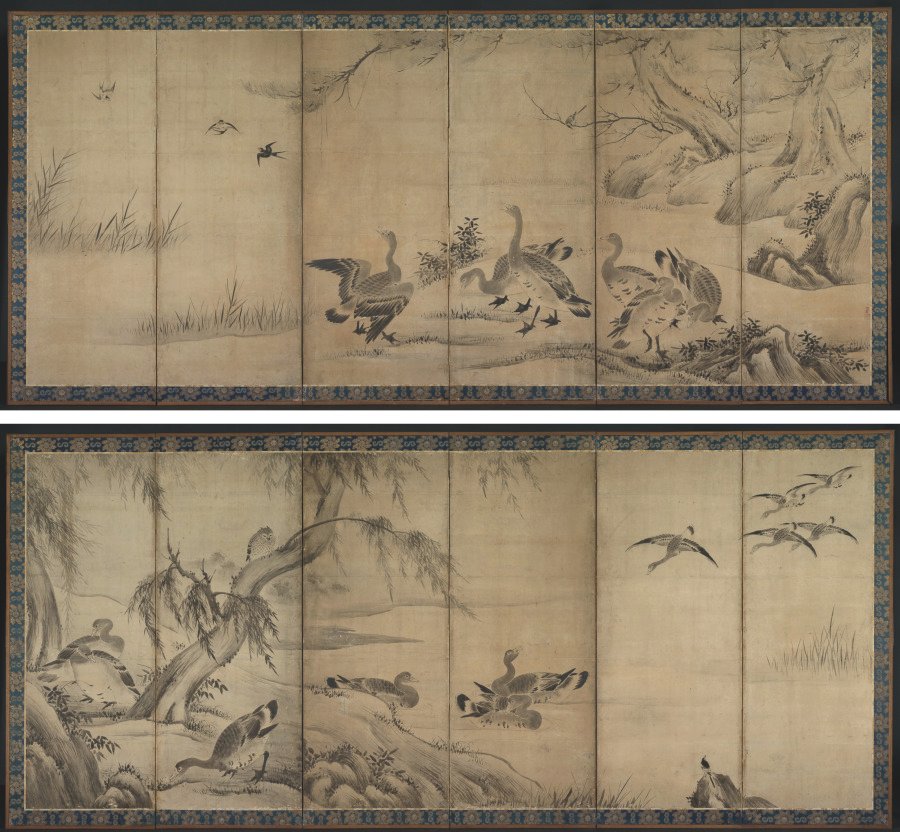
Depictions of geese usually appear as ink paintings in Japan during the 1200s. They later show up in the colorful landscapes of illustrated handscrolls. Such early ink renditions of the birds have long been associated with classical Chinese Zen painting and poetry, which was avidly admired and collected in medieval Japan. In these screens the artist portrayed the waterfowl in a pastoral setting without reference to classical or religious themes. Such ordinary subjects were imbued with special meaning in 14th- and 15th-century Japan through associations with continental culture, Zen thought and poetry, and famous Chinese monk-painters whose painting techniques had become revered as visual emblems of Zen principles. The screens here reflect the continuation of that painting tradition in the late 1500s or early 1600s by the head of the most important studio in Kyoto. Sanraku also executed a number of colorful folding screen compositions, but here he pays homage to the style of early Zen painting.
0 observed sales · 0 comparable sales · 2 structured provenance events · 2 structured exhibitions.