Comparable Sales
Same-artist public sales ranked by medium, creation year, dimensions and sale recency.
No public-rights comparable sales meet the current evidence criteria. RELICT does not fill the table with research-only or licensed-only facts.
Observed sale facts, comparable evidence, artist index history and modeled research remain separate.
Same-artist public sales ranked by medium, creation year, dimensions and sale recency.
(London Gallery, Ltd., Tokyo, Japan, sold to the Cleveland Museum of Art)
The Cleveland Museum of Art, Cleveland, OH
(London Gallery, Ltd., Tokyo, Japan, sold to the Cleveland Museum of Art) The Cleveland Museum of Art, Cleveland, OH
Selected Acquisitions. The Cleveland Museum of Art, Cleveland, OH (organizer) (February 9-April 11, 1993). Taming Tigers and Releasing Dragons: Masterpieces of Chinese Buddhist Art – Chinese Gallery Rotation 240a, 241c. The Cleveland Museum of Art (organizer) (February 8-August 11, 2019). Main Asian Rotation (Gallery 119). The Cleveland Museum of Art, Cleveland, OH (July 16-October 28, 2003).
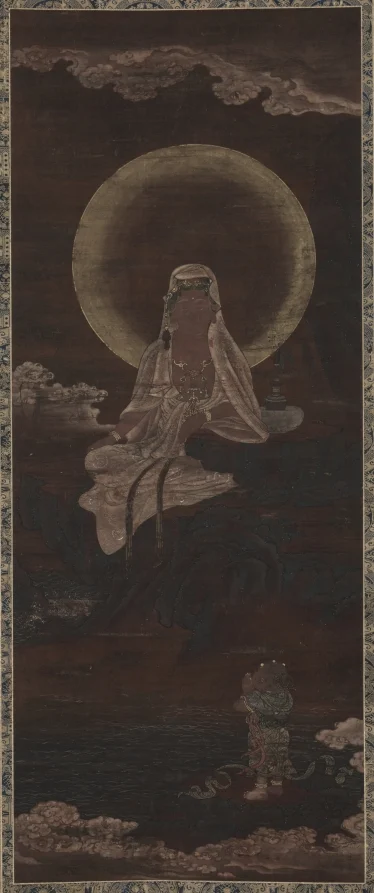
Kannon represents a primary figure of benevolence and compassion in the Buddhist pantheon. Identified early in Buddhist texts as a close attendant to the Buddha, by the 700s Kannon's popularity soared to such an extent in China, Korea, and Japan that the bodhisattva was often worshipped independently. Here at the lower left, Kannon is depicted with the child Zenzai Dōji (Sakskrit: Sudhana), a wealthy boy who, according to the final chapter of the <em>Flower Garland Sutra</em>, visited Kannon's abode Fudaraka (Sanskrit: Potalaka) during a long journey to learn the bodhisattva path.
0 observed sales · 0 comparable sales · 2 structured provenance events · 2 structured exhibitions.