Comparable Sales
Same-artist public sales ranked by medium, creation year, dimensions and sale recency.
No public-rights comparable sales meet the current evidence criteria. RELICT does not fill the table with research-only or licensed-only facts.

Observed sale facts, comparable evidence, artist index history and modeled research remain separate.
Same-artist public sales ranked by medium, creation year, dimensions and sale recency.
(Heeramaneck Galleries, New York, NY, sold to the Cleveland Museum of Art)
The Cleveland Museum of Art, Cleveland, OH
(Heeramaneck Galleries, New York, NY, sold to the Cleveland Museum of Art) The Cleveland Museum of Art, Cleveland, OH
Buddhist Art. Detroit Institute of Arts, Twenty-Fourth Loan Exhibition, October, 1942. Institute of Arts, Detroit, MI (October 1942).

Unknown artist · 1119
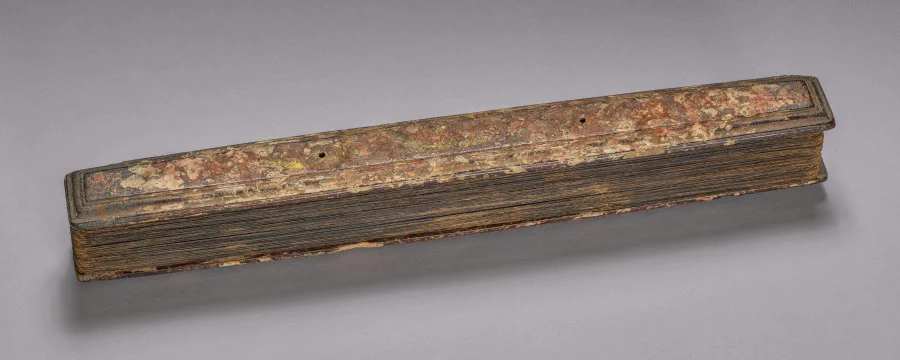
Unknown artist · 1119
Pieces of paper, sandalwood paste, vermilion powder, and spices like turmeric and saffron were ritually added to the top cover of this manuscript during its veneration in ceremonies honoring the Buddha’s teachings. Additionally, this wooden cover would have protected the fragile palm-leaf pages inside. A cord attached to a peg on the left side of the cover would have passed through the two binding holes and wrapped around the manuscript in order to evenly exert pressure and keep the leaves tight. The entire volume would have also been wrapped in cloth to further protect it from the elements and insect damage. Books in this format are very portable, as evidenced by the manuscript’s northward journey from the Vikramashila Monastery in eastern India to the Kathmandu Valley in Nepal.
0 observed sales · 0 comparable sales · 2 structured provenance events · 0 structured exhibitions.