Comparable Sales
Same-artist public sales ranked by medium, creation year, dimensions and sale recency.
No public-rights comparable sales meet the current evidence criteria. RELICT does not fill the table with research-only or licensed-only facts.
Observed sale facts, comparable evidence, artist index history and modeled research remain separate.
Same-artist public sales ranked by medium, creation year, dimensions and sale recency.
Dowager Duchess of Newcastle, widow of the sixth duke. Arnold & Tripp, Paris. Henry Reinhardt, deale...
Dowager Duchess of Newcastle, widow of the sixth duke. Arnold & Tripp, Paris. Henry Reinhardt, dealer, Chicago. Purchased from him in December 1910 by William G. Mather, Cleveland. Bequeathed to the CMA in 1951.
Cleveland, Kinney and Levan Building. Illustrated Catalogue of the Cleveland Art Loan Exposition Under the Auspices of the Cleveland School of Art (1913), no. 30c, L'étang à l'entrée du bois, lent by William G. Mather. CMA. (2 March-19 May 1920), no cat.
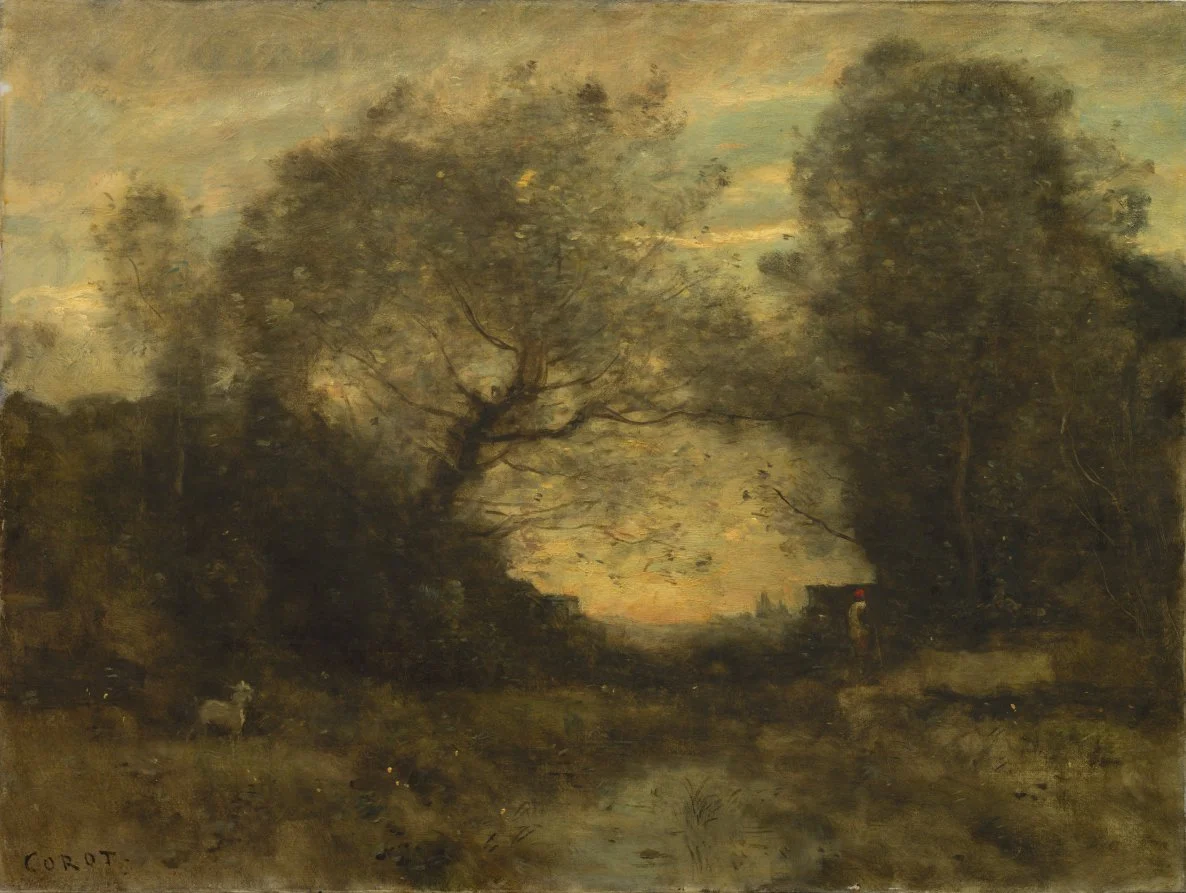
This scene of a pond bordered by large, leafy trees echoes Corot's well-known views of Ville-d'Avray, while the vaporous light and atmospheric effects within a restricted palette resemble those of the artist's late style of the 1860s and 1870s. The small forms of the peasant and white goat are also typical of Corot's late imagery. This is one of many views of a large pond at Ville-d'Avray, a small commune on the western suburbs of Paris, where Corot inherited a rural property from his parents.
0 observed sales · 0 comparable sales · 1 structured provenance events · 0 structured exhibitions.