Comparable Sales
Same-artist public sales ranked by medium, creation year, dimensions and sale recency.
No public-rights comparable sales meet the current evidence criteria. RELICT does not fill the table with research-only or licensed-only facts.
Observed sale facts, comparable evidence, artist index history and modeled research remain separate.
Same-artist public sales ranked by medium, creation year, dimensions and sale recency.
Estate of Breckinridge Long [1881–1958], Bowie, MD
(Harry Burke Antiques, Philadelphia, PA)
(Bernard Brown Agency, Milwaukee, WI, sold to the Cleveland Museum of Art. Purchased with funds from...
The Cleveland Museum of Art, Cleveland, OH
Estate of Breckinridge Long [1881–1958], Bowie, MD (Harry Burke Antiques, Philadelphia, PA) (Bernard Brown Agency, Milwaukee, WI, sold to the Cleveland Museum of Art. Purchased with funds from Mrs. A. Dean [Helen Wade Greene] Perry) The Cleveland Museum of Art, Cleveland, OH
Streams and Mountains Without End: Asian Art and the Legacy of Sherman E. Lee at the Cleveland Museum of Art. The Cleveland Museum of Art, Cleveland, OH (organizer) (June 27-August 23, 2009). Main gallery rotation (Gallery 245): November 2, 2015 - April 4, 2016.
Unknown artist · 1555
Unknown artist · 1555
Unknown artist · 1555
Unknown artist · 1555
Unknown artist · 1555
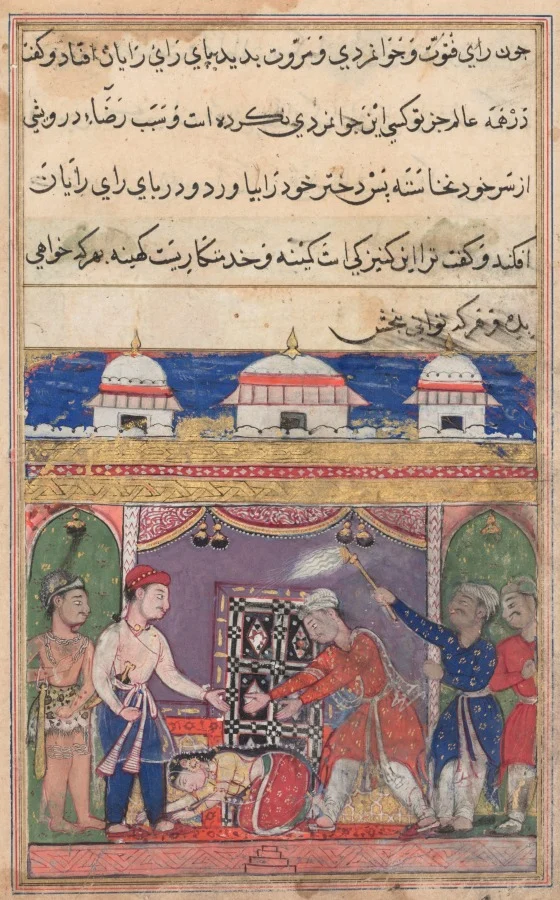
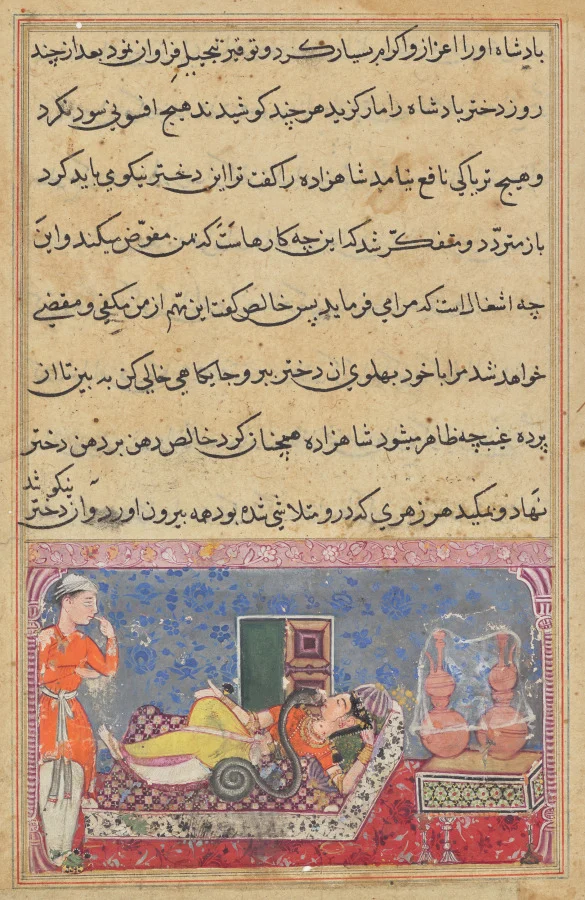
The local king was so moved by the gesture of the King of King’s in support of the dervish and by his cleverness at bringing his own head, still attached, that he offered his daughter in marriage to him. The princess, wearing Indian dress, is shown honoring his feet. The male figures wear the Central Asian dress of the Mughals, with a long belted tunic and pants. The King of Kings then allowed her to marry the dervish. A fancy door with geometric patterns is in the background, but it extends all the way down to the front of the floor, which has been tilted up, so that the tile pattern can be seen head-on. These fanciful manipulations of space are a hallmark of local Indian artistic practice.
0 observed sales · 0 comparable sales · 4 structured provenance events · 1 structured exhibitions.