Comparable Sales
Same-artist public sales ranked by medium, creation year, dimensions and sale recency.
No public-rights comparable sales meet the current evidence criteria. RELICT does not fill the table with research-only or licensed-only facts.
Observed sale facts, comparable evidence, artist index history and modeled research remain separate.
Same-artist public sales ranked by medium, creation year, dimensions and sale recency.
Edmond F. Got, Paris. London sale, Christie's, 20 February 1976 (lot 148), property of a Belgian col...
Edmond F. Got, Paris. London sale, Christie's, 20 February 1976 (lot 148), property of a Belgian collector, pl. 31, £1000. Shepherd Gallery, New York. Bought in February 1976 by Mr. and Mrs. Noah L. Butkin, Cleveland. Bequeathed to the CMA in 1980.
Year in Review: 1980. The Cleveland Museum of Art (organizer) (June 24-July 19, 1981).
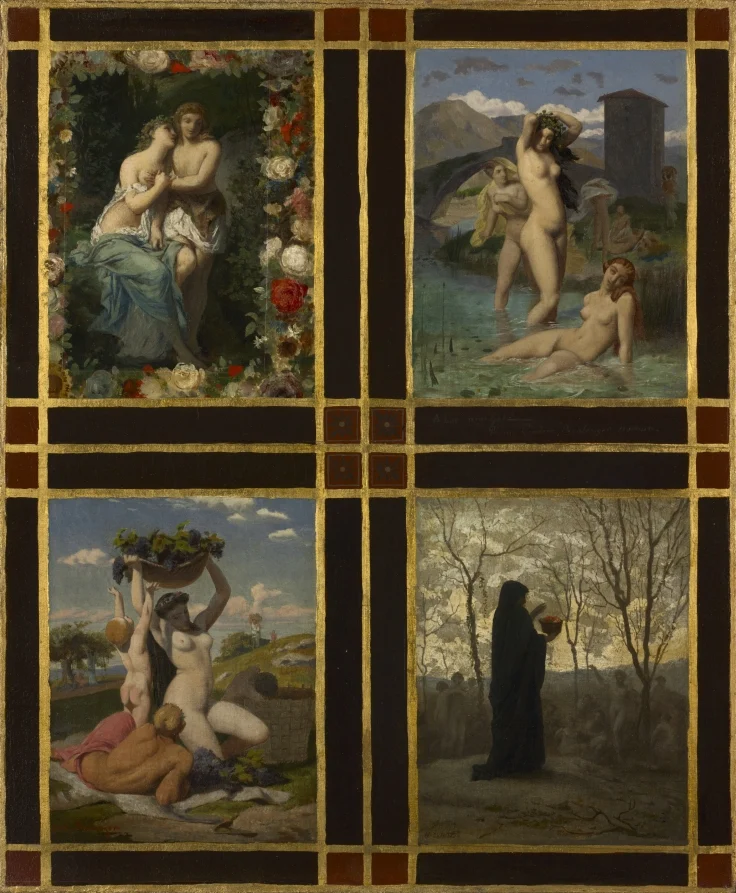
The artists who painted this work belonged to a group called the Néo-Grecs (New Greeks). They concentrated on depicting scenes of daily life in ancient Greece and Rome—often with an erotic slant. Here, relying on a popular Greco-Roman theme, the four works represent the seasons and their associated activities: the pursuit of love in spring; bathing in summer; harvesting grapes in fall; and a funerary ritual in winter. The decorative gold, black, and red borders also enhance the classical aspect of the work by recalling the painted wall decorations of the ancient Roman city of Pompeii. The artists painted this work for their friend, French actor Edmond Got (1822–1901). They likely presented this picture to him in commemoration of his election to the Comédie- Francaise acting company and as a memento of their friendship.
0 observed sales · 0 comparable sales · 1 structured provenance events · 1 structured exhibitions.