Comparable Sales
Same-artist public sales ranked by medium, creation year, dimensions and sale recency.
No public-rights comparable sales meet the current evidence criteria. RELICT does not fill the table with research-only or licensed-only facts.
Observed sale facts, comparable evidence, artist index history and modeled research remain separate.
Same-artist public sales ranked by medium, creation year, dimensions and sale recency.
Possibly the Carthusian monastery of Saint Barbara, Cologne.[1] Richard von Schnitzler [1855-1938],...
sold 1953 to (M. Knoedler & Co., New York)
[3] purchased 1954 by the Samuel H. Kress Foundation, New York
[4] gift 1961 to NGA.
[1] Although unverified it is possible, as Eisler first suggested, that _The Crucifixion_ was origin...
[2] Walter Bombe, "Die Sammlung Dr. Richard von Schnitzler in Cöln." _Der Cicerone_ 9 (1917): 366....
[3] M. Knoedler & Co. Records, accession number 2012.M.54, Research Library, Getty Research Institut...
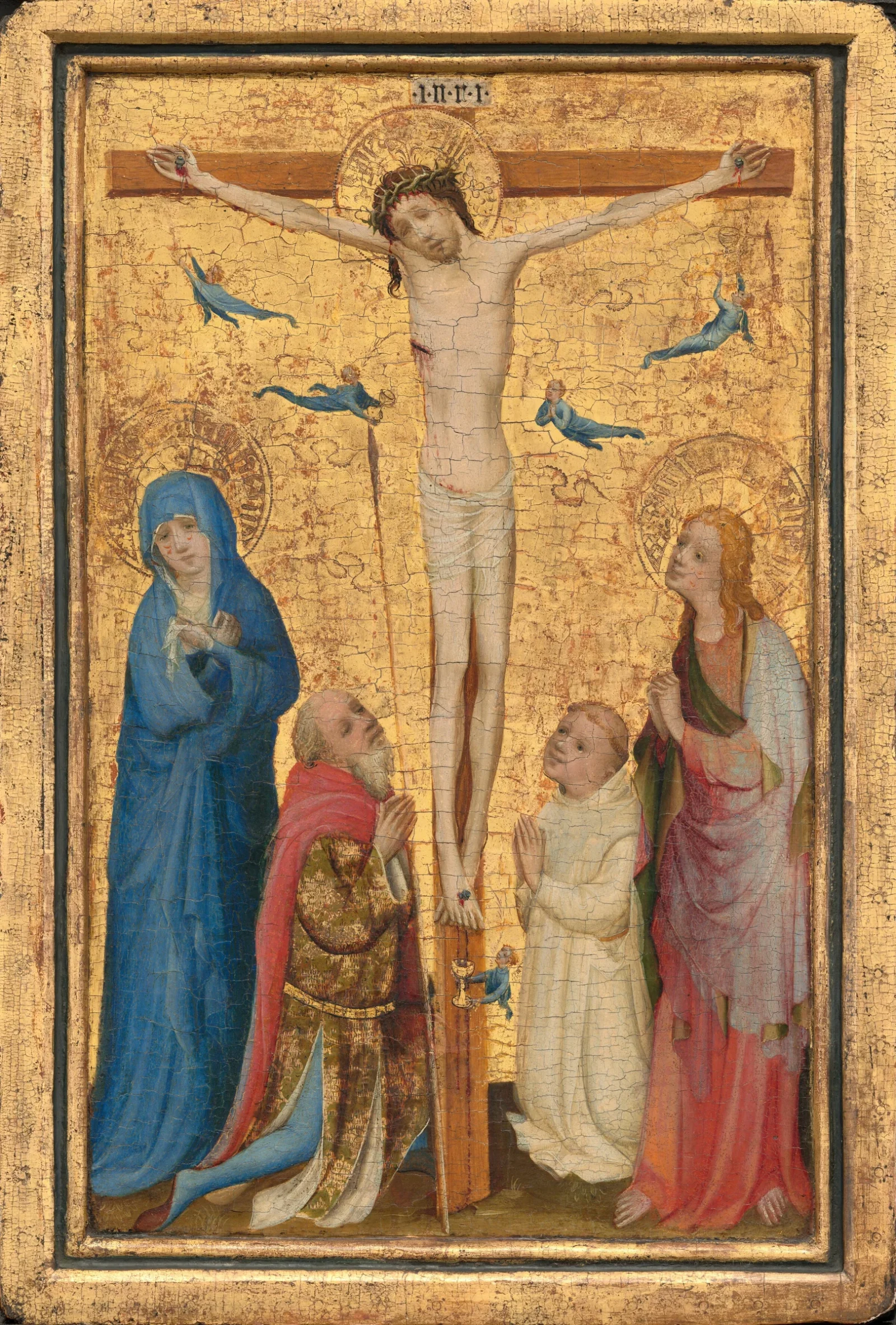
Possibly the Carthusian monastery of Saint Barbara, Cologne.[1] Richard von Schnitzler [1855-1938], Cologne, by 1917 until at least 1931.[2] (Pinakos, Inc. [Rudolf Heinemann]); sold 1953 to (M. Knoedler & Co., New York);[3] purchased 1954 by the Samuel H. Kress Foundation, New York;[4] gift 1961 to NGA. [1] Although unverified it is possible, as Eisler first suggested, that _The Crucifixion_ was originally located in the Charterhouse of Saint Barbara in Cologne, the city where the Master of Saint Veronica was active as well as the birthplace of Saint Bruno, founder of the Carthusian Order. The Charterhouse in Cologne was a large and important institution that underwent a major building campaign between 1391 and 1405. (see J.J. Merlo, "Kunst und Kunsthandwerk im Karthäuserkloster zu Köln", _Annalen des historischen Vereins für den Niederrhein insbesondere die alte Erzdiöcese Köln_, 45 (1886): 1-2. See also Paul Clemen, Ludwig Arntz, Hugo Rahtgens, Heinrich Neu, and Hans Vogts, _Die Kunstdenkmäler der Stadt Köln_, vol. 2, part 3 (Düsseldorf, 1934), 137-162, and Otto Braunsberger, "Die Kölner Kartause. Erinnerungen aus alter Zeit," _Stimmen der Zeit. Katholische Monatschrift für das Geistesleben der Gegenwart_, 94 (1918): 134-152. If the Gallery's panel were in the Charterhouse, it might have remained there until 1794 when the monastery was dispersed.) Given the Order's emphasis on solitary contemplation and devotion, it would seem likely that the Gallery's panel adorned the cell of a single monk. It is possible that it was originally part of a commission for multiple images, as was the case with the Crucifixions painted by Jean de Beaumetz and his shop for the Charterhouse at Champmol. (Noted by Colin Eisler, _Paintings from the Samuel H. Kress Collection: European Schools Excluding Italian_. (Oxford, 1977), 1. [2] Walter Bombe, "Die Sammlung Dr. Richard von Schnitzler in Cöln." _Der Cicerone_ 9 (1917): 366. Published in Otto Helmut Förster, _Die Sammlung Dr. Richard von Schnitzler_, Munich, 1931: 21, no. 1, pl. 1. Unless sold by Schnitzler between 1931 and his death in 1938, the painting was inherited by his two daughters, Edith and Eriak von Schröder. [3] M. Knoedler & Co. Records, accession number 2012.M.54, Research Library, Getty Research Institute, Los Angeles: Stock book no. 10, p. 104, no.A5322, and Sales book no. 17, p. 37 (copies in NGA curatorial files). A pencilled notation indicates that the panel was previously owned by a Dr. Howard in partnership with Mont and Newhouse. [4] See The Kress Collection Digital Archive, https://kress.nga.gov/Detail/objects/2121.
The Crucifixion is a work by Master of Saint Veronica. dated c. 1400/1410. made in tempera on panel. with recorded dimensions overall (design area): 40.7 × 25.2 cm (16 × 9 15/16 in.) framed (engaged frame): 46.2 × 31.1 × 3 cm (18 3/16 × 12 1/4 × 1 3/16 in.). The work is recorded by National Gallery of Art under accession 1961.9.29.
2 observed sales · 0 comparable sales · 8 structured provenance events · 0 structured exhibitions.