Comparable Sales
Same-artist public sales ranked by medium, creation year, dimensions and sale recency.
No public-rights comparable sales meet the current evidence criteria. RELICT does not fill the table with research-only or licensed-only facts.
Observed sale facts, comparable evidence, artist index history and modeled research remain separate.
Same-artist public sales ranked by medium, creation year, dimensions and sale recency.
Ming imperial collection [Jingtai era, 1450–1456]
(Shunichi Yabumoto Co., Ltd., Tokyo, Japan, sold to the Cleveland Museum of Art)
The Cleveland Museum of Art, Cleveland, OH
Ming imperial collection [Jingtai era, 1450–1456] (Shunichi Yabumoto Co., Ltd., Tokyo, Japan, sold to the Cleveland Museum of Art) The Cleveland Museum of Art, Cleveland, OH
Eight Dynasties of Chinese Painting. The Nelson-Atkins Museum of Art (November 7, 1980-January 4, 1981); The Cleveland Museum of Art (February 11-March 29, 1981); Tokyo National Museum (October 4-November 17, 1982); The Asia Society Museum, New York, NY (December 3, 1982-February 28, 1983). Latter Days of the Law: Images of Chinese Buddhism 850-1850. Spencer Museum of Art (August 9-October 31, 1994); Asian Art Museum of San Francisco (November 30, 1994-January 29, 1995). Taming Tigers and Releasing Dragons: Masterpieces of Chinese Buddhist Art – Chinese Gallery Rotation 240a, 241c. The Cleveland Museum of Art (organizer) (February 8-August 11, 2019). Monk Artisans of the Joseon Dynasty. National Museum of Korea, Seoul, Korea (Republic of) (organizer) (December 6, 2021-March 6, 2022).
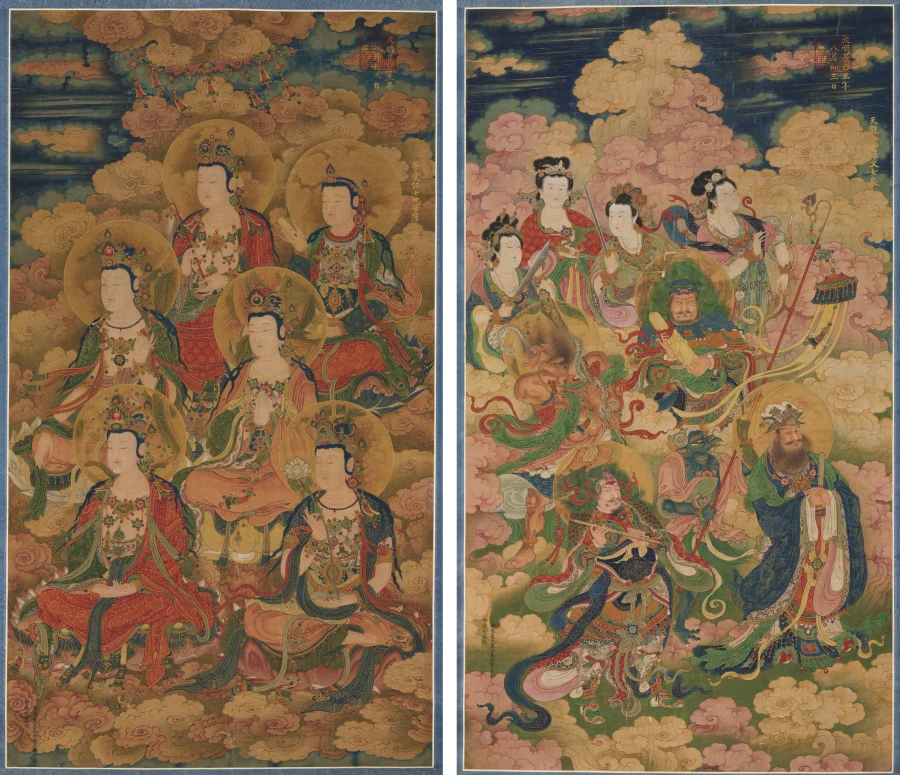
The grandest of the Buddhist mortuary rites is the Water-Land (<em>shuilu</em>) ritual. This esoteric ceremony is conducted for the salvation of “all souls of the dead on land and sea.” The ostentatious ritual was performed for imperial ancestors and high officials from the Song (960–1279) to the Ming dynasties and drew large crowds. On the second day of the weeklong ceremony, paintings are hung in the inner altar. <br><br>These two scrolls belong to a set of 36 Water-Land ritual paintings that are the finest works of their types known from the Ming period. With their bright, opaque color and fine-line gilt decoration intact and unfaded, both paintings share a remarkable state of preservation.<br><br>In the upper right corner of each painting is an imperial seal and an inscription in gold reading: <em>Donated on the third day of the eighth month in the fifth year of the Jingtai reign (1454) of the Great Ming</em>. Written in ink in the lower left corner is the record that they were made on imperial order, probably to present them to the Da Longfu monastery in Beijing.<br><br>One scroll represents the Eight Hosts of Celestial Nagas and Yakshis as described in the <em>Lotus Sutra</em>. The other represents Bodhisattvas of the Ten Stages of Enlightenment undergoing the final processes toward Buddhahood. The sinuous curves of scarf and drapery, the layering of garments, and the minute detail all reflect the opulent visual atmosphere that surrounded the Ming worshipper in temples and spirit halls throughout the country.
0 observed sales · 0 comparable sales · 3 structured provenance events · 4 structured exhibitions.