Comparable Sales
Same-artist public sales ranked by medium, creation year, dimensions and sale recency.
No public-rights comparable sales meet the current evidence criteria. RELICT does not fill the table with research-only or licensed-only facts.
Observed sale facts, comparable evidence, artist index history and modeled research remain separate.
Same-artist public sales ranked by medium, creation year, dimensions and sale recency.
Church in Peralta de la Sal, sold to Celestino Dupont
Celestino Dupont, France
French and Company, New York, NY, sold to Frank H. Ginn
Frank H. Ginn, Cleveland, OH, gifted to the Cleveland Museum of Art
The Cleveland Museum of Art, Cleveland, OH
Church in Peralta de la Sal, sold to Celestino Dupont Celestino Dupont, France French and Company, New York, NY, sold to Frank H. Ginn Frank H. Ginn, Cleveland, OH, gifted to the Cleveland Museum of Art The Cleveland Museum of Art, Cleveland, OH
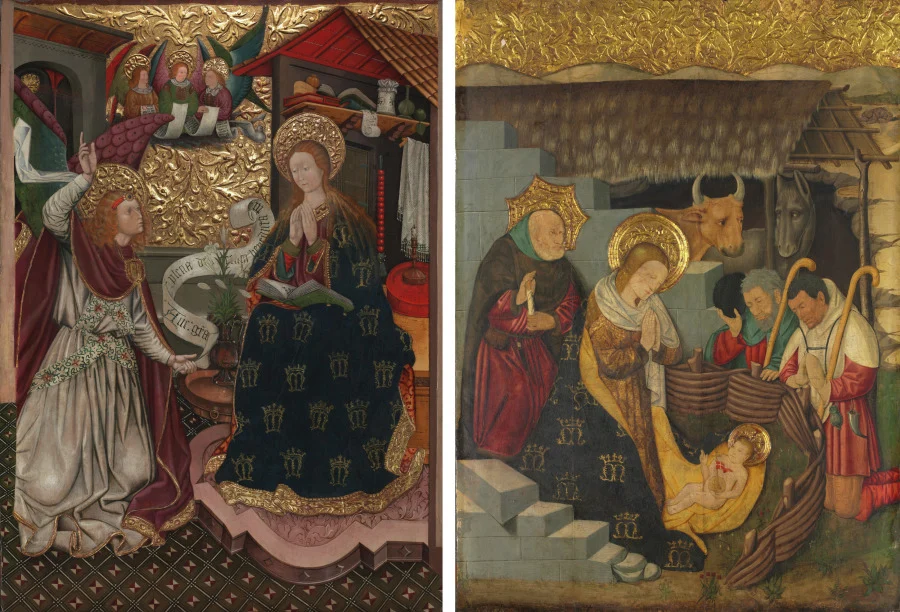
These paintings are believed to be the remaining components of a six-panel altarpiece. The large central panel is now preserved in Barcelona (Museu National d’Art de Catalunya). Ferrer collaborated with the painter Pere Garcia de Benavarri on this commission. Spanish works like these often feature elaborate treatment of the gold background, evident here in the exuberant raised decoration (called pastiglia) in the skies and the haloes, as well as other details. Here the Archangel Gabriel proclaims the Virgin’s destiny as the mother of Christ. The setting is an ordinary house, but simple objects have symbolic meaning. The lilies represent the Virgin’s purity; the covered jar and water carafe symbolize inviolability; the pomegranate symbolizes Christ’s resurrection, while the apple alludes to humankind’s fall from grace. The two books, closed and open, refer respectively to the Old and New Testaments: one foretelling and the other fulfilling the promise of the messiah. Both The Annunciation and The Nativity were components of a large altarpiece probably dedicated to the Virgin. Spanish works like these often feature elaborate treatment of the gold background, evident here in the exuberant raised decoration (called pastiglia) in the skies and haloes, as well as other details such as the vase of lilies in the Annunciation. The Annunciation The archangel Gabriel, gesturing toward God in a window above, proclaims the Virgin's destiny as the mother of Christ. Gabriel holds a scroll with the words from the New Testament (in Latin) "Hail Mary, full of grace, the Lord is with you." The angels in the sky hold another scroll proclaiming: "Glory to God in the highest, and peace to good people on earth". The simple objects surrounding the Virgin appear to be the furnishings of an ordinary house, but they carry symbolic meaning. The lilies represent the Virgin's purity; the covered jar and the water carafe symbolize inviolability. The towel and basin hint at ritual cleansing during Mass. The blown out candle points to the arrival of divine light in the world. The pomegranate symbolizes Christ's resurrection, while the apple alludes to humankind's fall from grace. The two books, closed and open, refer respectively to the Old and New testaments: one foretelling and the other fulfilling the promise of the Messiah.
0 observed sales · 0 comparable sales · 5 structured provenance events · 0 structured exhibitions.