Comparable Sales
Same-artist public sales ranked by medium, creation year, dimensions and sale recency.
No public-rights comparable sales meet the current evidence criteria. RELICT does not fill the table with research-only or licensed-only facts.
Observed sale facts, comparable evidence, artist index history and modeled research remain separate.
Same-artist public sales ranked by medium, creation year, dimensions and sale recency.
Victor-Amédée, prince de Carignan, 1690-1741 (Paris, France)
possibly claimed by L. J. Landrin (Paris, France), 1736
Duc de Choiseul et Mantachef
Wildenstein, Paris
Henry G. Dalton, Cleveland
Harry E. Kendrick (Cleveland, Ohio), by gift to the Cleveland Museum of Art, 1952.
Victor-Amédée, prince de Carignan, 1690-1741 (Paris, France) possibly claimed by L. J. Landrin (Paris, France), 1736 Duc de Choiseul et Mantachef Wildenstein, Paris Henry G. Dalton, Cleveland Harry E. Kendrick (Cleveland, Ohio), by gift to the Cleveland Museum of Art, 1952.
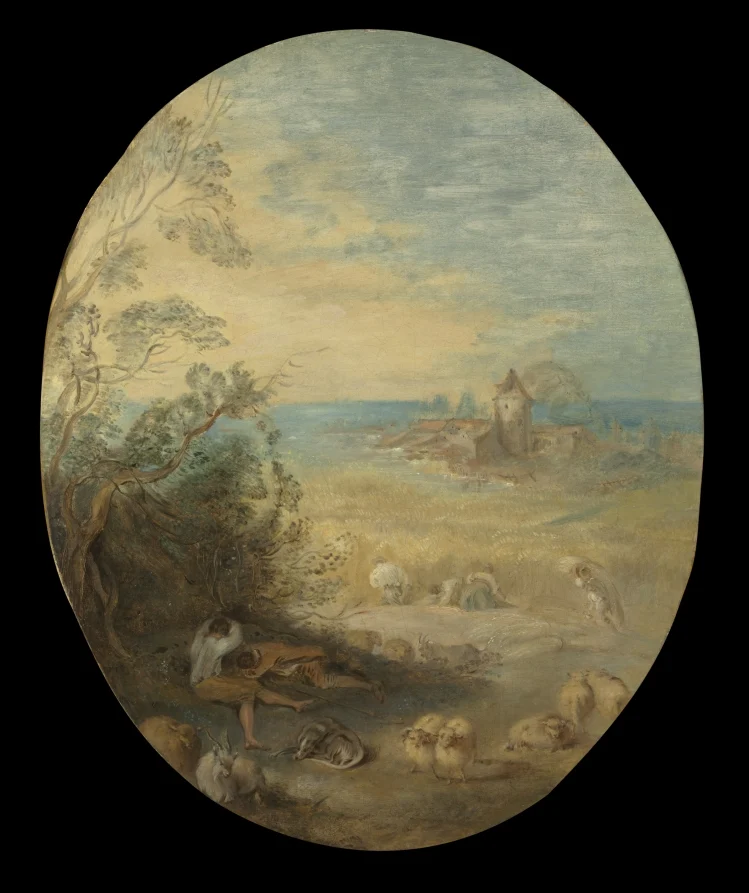
<em>Spring</em> and <em>Summer</em> are two scenes from a series of the four seasons. Both <em>Autumn</em> and<em> Winter</em> are now in the Museu d'Art de Catalunya in Barcelona. These landscapes were originally a part of a screen or a decorative panel, as indicated by their floral borders and oval shape. The setting of <em>Spring</em> is believed to be the grounds of Montmorency, the country estate of Pierre Crozat (1665-1740), a wealthy financier and art collector in early eighteenth-century Paris. The walkway is very similar to other scenes by Watteau known to depict the estate of his close friend and patron Crozat. As a student of Watteau, Pater would have also been familiar with this setting. <em>Summer</em> counters <em>Spring</em>'s aristocratic leisure by depicting rural labor. However, befitting the work's decorative origins, Pater's scene belongs to the tradition of the timeless pastoral. More idyllic than a statement about class differences, the reapers peacefully gather sheaves of wheat as shepherds rest with their flocks in the foreground.
0 observed sales · 0 comparable sales · 6 structured provenance events · 0 structured exhibitions.