Comparable Sales
Same-artist public sales ranked by medium, creation year, dimensions and sale recency.
No public-rights comparable sales meet the current evidence criteria. RELICT does not fill the table with research-only or licensed-only facts.
Observed sale facts, comparable evidence, artist index history and modeled research remain separate.
Same-artist public sales ranked by medium, creation year, dimensions and sale recency.
Decamps sale, Paris, Drouot, 23-24 January 1865 (lots 26, 27), bought by M. Desprez for ff 300, ff 2...
Decamps sale, Paris, Drouot, 23-24 January 1865 (lots 26, 27), bought by M. Desprez for ff 300, ff 225. His collection sale, Versailles, 17 December 1972 (lot 218), to Georges Martin du Nord at Galerie B. G. Verte, Paris. Sold to Galerie Brame-Lorenceau, Paris. Bought by Mr. and Mrs. Noah L. Butkin, Cleveland. Bequeathed to the CMA in 1980.
CMA. Chardin and the Still-Life Tradition in France (1979), 61, 85, 90, figs. 18, 19.
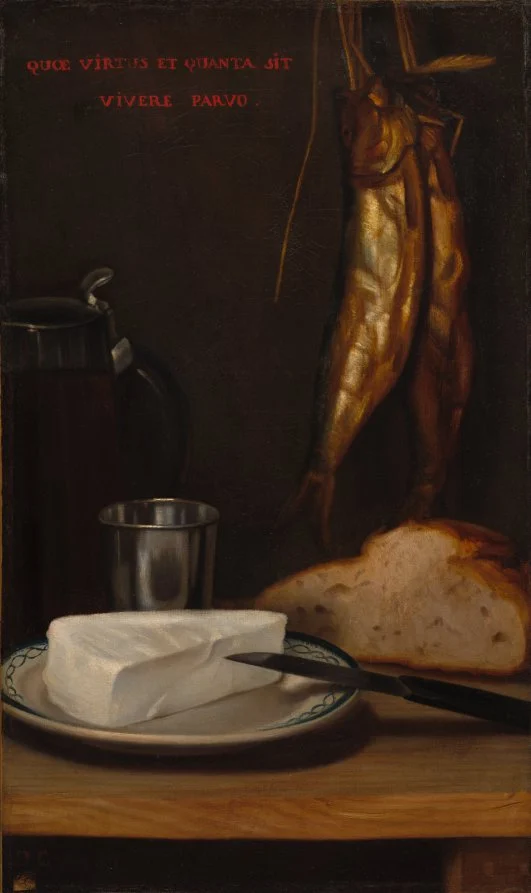
This painting forms a pair with the <em>Still Life with Pipe and Matches</em>. Along with several other paintings, they decorated the dining room of the artist's home, each painting representing a different stage of a meal. In this composition the artist focused his attention on rendering textures, which are as varied as the objects themselves: the skin of the smoked herrings, whose highlights echo the silver of the goblet and the cover of the pitcher; the spongy surface of the bread; the velvety crust of the cheese; and finally the soft wood surface (pine?) that supports this still life. The Latin inscription translates: "How virtuous and how great to live with simple things."
0 observed sales · 0 comparable sales · 1 structured provenance events · 0 structured exhibitions.