Comparable Sales
Same-artist public sales ranked by medium, creation year, dimensions and sale recency.
No public-rights comparable sales meet the current evidence criteria. RELICT does not fill the table with research-only or licensed-only facts.
Observed sale facts, comparable evidence, artist index history and modeled research remain separate.
Same-artist public sales ranked by medium, creation year, dimensions and sale recency.
S. Maria della Scala, Siena. J
Johann Anton Ramboux, Cologne (bought in Siena, c. 1838, Cologne sale 1867).
Hohenzollern family, Sigmaringen (sold 1920).
Adolphe Stoclet, Brussels (1921, sold 1966).
(R. Heinemann, New York, 1966).
The Cleveland Museum of Art, Cleveland, OH
S. Maria della Scala, Siena. J Johann Anton Ramboux, Cologne (bought in Siena, c. 1838, Cologne sale 1867). Hohenzollern family, Sigmaringen (sold 1920). Adolphe Stoclet, Brussels (1921, sold 1966). (R. Heinemann, New York, 1966). The Cleveland Museum of Art, Cleveland, OH
Golden Anniversary of Acquisitions. The Cleveland Museum of Art, Cleveland, OH (organizer) (September 10-October 16, 1966). Lust und Verlust: Kölner Sammler zwischen Trikolore und Preussenadler (Joy and Loss: Cologne Collectors between the tricolore and the Prussian eagle). Josef Haubrich Kunsthalle (October 24, 1995-January 14, 1996). Sanctity Pictured: The Art of the Dominican and Franciscan Orders in Renaissance Italy. Frist Art Museum, Nashville, TN (organizer) (October 31, 2014-January 25, 2015).
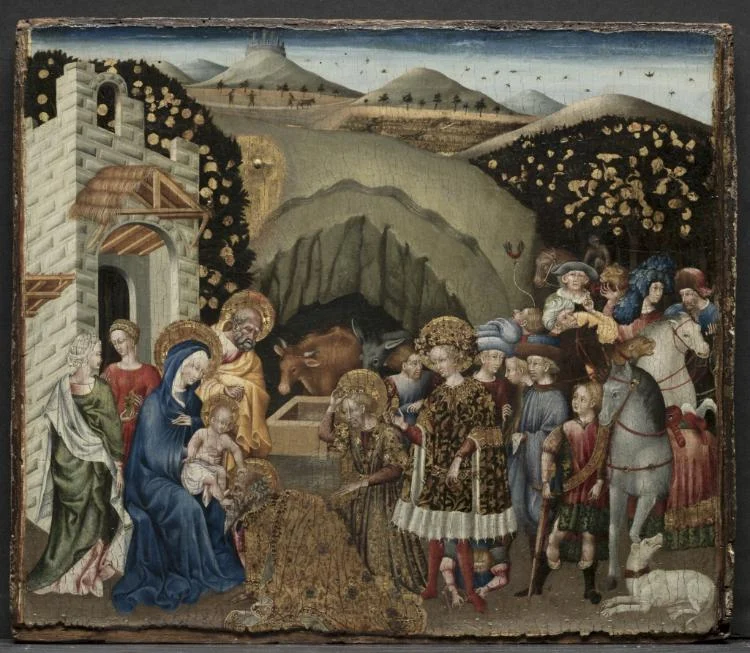
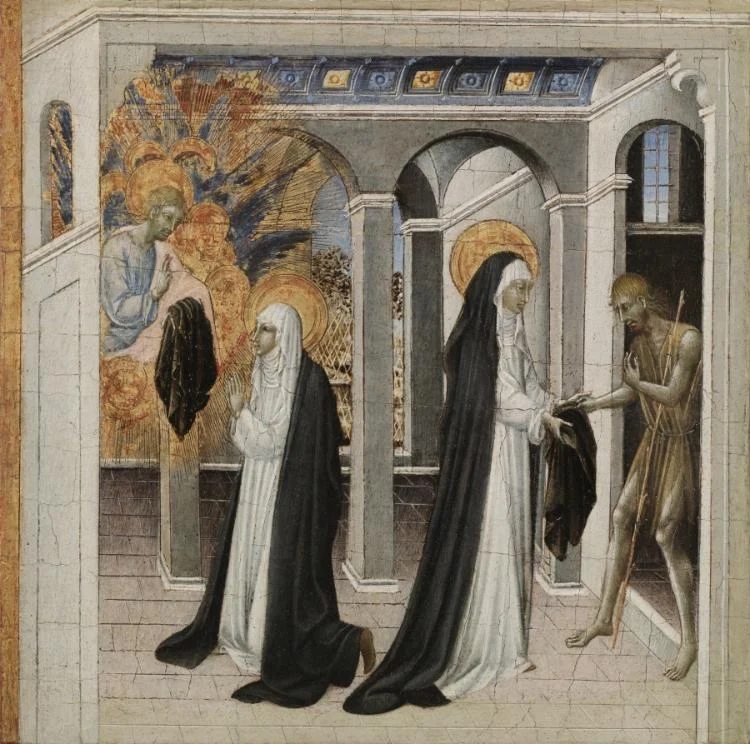
Saint Catherine (1347-1380) was the daughter of a prosperous Sienese cloth dyer. At the age of six, she saw a vision of Christ and thereafter dedicated herself to chastity, penance, and good works. She became much beloved in Siena for selflessly caring for victims of the Black Death. This panel, with 1966.2, was once part of a predella (or pedestal) of a large altarpiece painted for the Hospital Church of Siena. The main scene of this altarpiece, showing the Presentation of Christ in the Temple (now preserved in Siena) was ordered by the Pork Butchers Guild (the Pizzicaiuoli) in 1447. The predella was added later when Catherine was canonized in 1461. In the first panel, she kneels before an altar and reaches up to choose from the monastic garments offered by Saints Dominic, Augustine, and Francis, all founders of religious orders. Catherine takes the habit of Saint Dominic, which she wore as the founder of the Sisters of Penance. The second panel shows, at the right, Saint Catherine giving her cloak to a beggar. The beggar was really Christ in disguise, and at the left returns the cloak to her. For this act of charity, the cloak perpetually protected its wearer from the cold.
0 observed sales · 0 comparable sales · 6 structured provenance events · 3 structured exhibitions.