Comparable Sales
Same-artist public sales ranked by medium, creation year, dimensions and sale recency.
No public-rights comparable sales meet the current evidence criteria. RELICT does not fill the table with research-only or licensed-only facts.
Observed sale facts, comparable evidence, artist index history and modeled research remain separate.
Same-artist public sales ranked by medium, creation year, dimensions and sale recency.
(James J. Freeman, Kyoto, Japan, sold to the Cleveland Museum of Art)
The Cleveland Museum of Art, Cleveland, OH
(James J. Freeman, Kyoto, Japan, sold to the Cleveland Museum of Art) The Cleveland Museum of Art, Cleveland, OH
Animals in Japanese Art. The Cleveland Museum of Art, Cleveland, OH (organizer) (June 24-December 10, 2023).
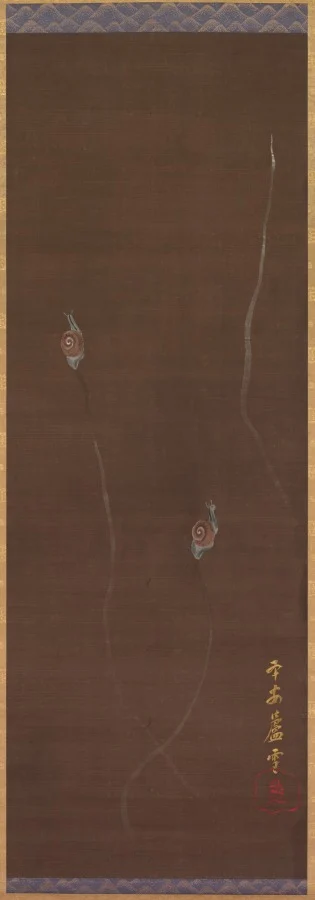
In this work, Nagasawa Rosetsu carefully described two snails in a manner known as “earth painting” (<em>doro-e</em>), building up colors mixed with crushed white shells in emulation of the thick brushstrokes of oil paint seen in European painting. A silvery metallic pigment indicates the snails’ trails, glistening along an earthen wall. Notably, one trail has no snail, leaving the viewer to guess why.
0 observed sales · 0 comparable sales · 2 structured provenance events · 1 structured exhibitions.