Comparable Sales
Same-artist public sales ranked by medium, creation year, dimensions and sale recency.
No public-rights comparable sales meet the current evidence criteria. RELICT does not fill the table with research-only or licensed-only facts.

Observed sale facts, comparable evidence, artist index history and modeled research remain separate.
Same-artist public sales ranked by medium, creation year, dimensions and sale recency.
Ananda K. Coomaraswamy [1877–1947] sold to the Cleveland Museum of Art
The Cleveland Museum of Art, Cleveland, OH
Ananda K. Coomaraswamy [1877–1947] sold to the Cleveland Museum of Art The Cleveland Museum of Art, Cleveland, OH
The Silver Jubilee Exhibition. The Cleveland Museum of Art, Cleveland, OH (organizer) (June 23-September 28, 1941). East Indian Art. The Detroit Institute of Arts, Detroit, MI (organizer) (February 10-March 29, 1942). Exhibition of the Month: Music in Art. The Cleveland Museum of Art, Cleveland, OH (organizer) (October 2, 1945-February 4, 1946). Exhibition of the Month: Jewelry of India. The Cleveland Museum of Art, Cleveland, OH (organizer) (April 1-June 2, 1947). India's Art. The Cleveland Museum of Art, Cleveland, OH (organizer) (December 2, 1949-January 22, 1950). Dance of the Gods: Indian Art Inspired by Music. The Cleveland Museum of Art, Cleveland, OH (organizer) (September 24-December 8, 1996). Indian Gallery 242 Rotation – April-November 2017. The Cleveland Museum of Art (organizer) (April 10-November 6, 2017). Rajput Painting. Asia House, New York, NY (December 3, 1960-January 22, 1961). Main gallery rotation (gallery 245). The Cleveland Museum of Art, Cleveland, OH (November 2, 2015-April 4, 2016).

Unknown artist · 1336

Unknown artist · 1610

Unknown artist · 1200
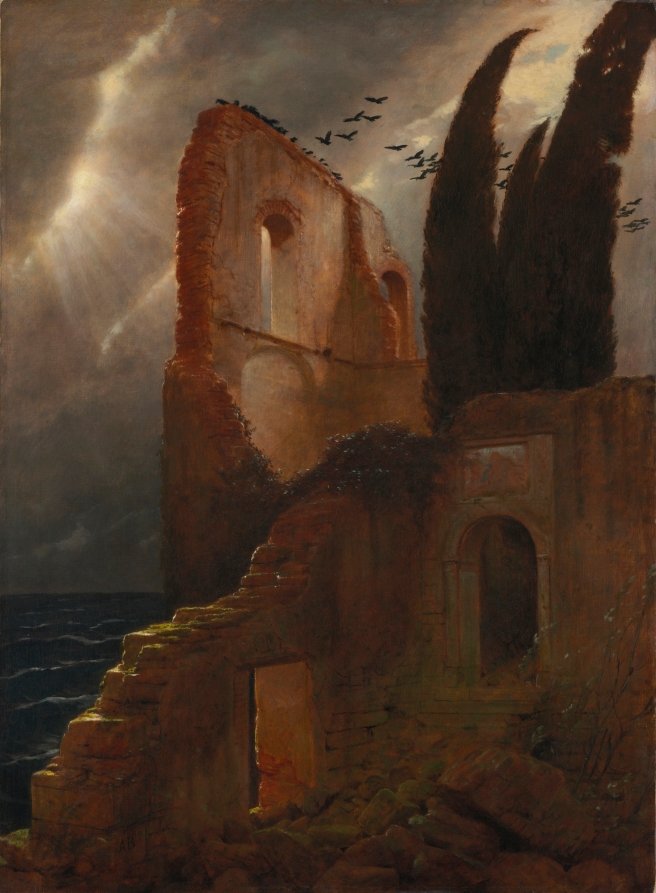
Arnold Böcklin (Swiss, 1827–1901) · 1881

Tawaraya Sōtatsu (Japanese, c. 1570–c. 1640) · 1600
This painting is from an important series made at a turning point in the history of court painting at the Rajput kingdom of Mewar. For the first time, a royal patron, Amar Singh II (r. 1698–1710), even before his accession to the throne, decided to incorporate Mughal elements into secular art, as seen in the white domed architecture and interest in conveying some sense of spatial depth. Nevertheless, the artist still adheres to the use of horizontal registers and bold planes of color. The codified iconography of Shri Raga involves a royal couple listening to recitations. Shri Raga is described as: "Splendidly enthroned of peerless beauty and lovely as the autumn moon, he sits hearing stories from Narada and Tumburu. By the great sages he is called Shri Raga King." Amar Singh has playfully substituted his own portrait for that of the generic king, and a woman for that of the sage. In music, Shri Raga is associated with the season of autumn and the harvest festivals, here evoked by the dancing female musicians in the lower register.
0 observed sales · 0 comparable sales · 2 structured provenance events · 7 structured exhibitions.