Comparable Sales
Same-artist public sales ranked by medium, creation year, dimensions and sale recency.
No public-rights comparable sales meet the current evidence criteria. RELICT does not fill the table with research-only or licensed-only facts.
Observed sale facts, comparable evidence, artist index history and modeled research remain separate.
Same-artist public sales ranked by medium, creation year, dimensions and sale recency.
(John D. MacDonald, Manchester, NH, sold to the Cleveland Museum of Art)
The Cleveland Museum of Art, Cleveland, OH
(John D. MacDonald, Manchester, NH, sold to the Cleveland Museum of Art) The Cleveland Museum of Art, Cleveland, OH
Italian Drawings with von Hirsh Acquisitions. The Cleveland Museum of Art (organizer) (September 15-December 4, 1978). The Twain Shall Meet. The Cleveland Museum of Art, Cleveland, OH (organizer) (October 30, 1985-January 5, 1986). Treasury of the World: Jeweled Arts of India in the Age of the Mughals. The Cleveland Museum of Art, Cleveland, OH (February 24-May 19, 2002). Indian Miniature Rotation (Gallery 115). The Cleveland Museum of Art, Cleveland, OH (August 13, 2003-February 18, 2004). Indian Miniature Rotation (Gallery 115). The Cleveland Museum of Art, Cleveland, OH (August 18, 2004-May 23, 2005). Main Asian Rotation (Gallery 245). The Cleveland Museum of Art, Cleveland, OH (July 2, 2014-January 5, 2015).
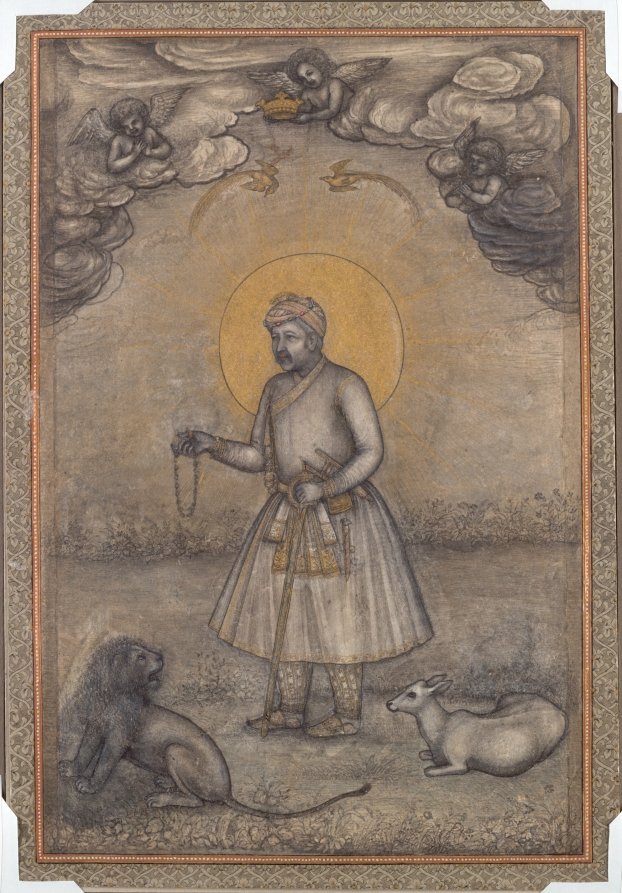
The soulful modeling of Akbar’s aged but dignified face argues strongly in favor of the attribution of this work to the imperial court artist Govardhan. This posthumous portrait of the celebrated third Mughal emperor would have been made at the end of his career for Akbar’s grandson Shah Jahan, who reigned from 1626 to 1648. Shah Jahan glorifies his own august lineage by lionizing Akbar and having him portrayed in a formal, symbolic way that Akbar himself never would have commissioned. Christian angels in European style praise him from the heavens, while mythical birds of paradise swoop at the edge of the radiance emitted from the nimbus of the divine light of his rule. He originally grasped an orb, which was changed to a necklace. The sensitively articulated body of a young cow reclines at ease in the presence of a lion, indicating the harmony and peace of his noble rule. The artist used the dignified <em>nim-qalam</em> style of painted drawing with only touches of gold and hints of color. Heavy outlines were added at a later date, along with pinprick holes used for copying the composition onto another sheet of paper.
0 observed sales · 0 comparable sales · 2 structured provenance events · 3 structured exhibitions.