Comparable Sales
Same-artist public sales ranked by medium, creation year, dimensions and sale recency.
No public-rights comparable sales meet the current evidence criteria. RELICT does not fill the table with research-only or licensed-only facts.
Observed sale facts, comparable evidence, artist index history and modeled research remain separate.
Same-artist public sales ranked by medium, creation year, dimensions and sale recency.
(N. V. Hammer, Inc., New York, NY, sold to the Cleveland Museum of Art)
The Cleveland Museum of Art, Cleveland, OH
(N. V. Hammer, Inc., New York, NY, sold to the Cleveland Museum of Art) The Cleveland Museum of Art, Cleveland, OH
Year in Review: 1965. The Cleveland Museum of Art, Cleveland, OH (organizer) (October 27-November 14, 1965). Obaku: Zen Painting and Calligraphy. Helen Foresman Spencer Museum of Art, Lawrence, KS (organizer) (April 8-May 31, 1978); New Orleans Museum of Art, New Orleans, LA (June 15-August 6, 1978). Journey of the Three Jewels: Japanese Buddhist Paintings in Western Collections. Asia House Galleries, New York City, NY (organizer) (October 11-December 9, 1979); Denver Art Museum, Denver, CO (March 27-May 11, 1980). 日本の仏教を築いた人びと: その肖像と書 (Those Who Built Japanese Buddhism: Portraits and Calligraphy). Nara National Museum, Nara 630, Japan (organizer) (April 29-June 7, 1981). Reflections of Reality in Japanese Art. The Cleveland Museum of Art, Cleveland, OH (organizer) (March 16-May 1, 1983). Portraiture: The Image of the Individual. The Cleveland Museum of Art, Cleveland, OH (organizer) (November 22, 1983-January 22, 1984). The Art of Obaku. Kyoto National Museum (organizer) (October 5-November 7, 1993). Admired from Afar: Masterworks of Japanese Painting from the Cleveland Museum of Art. Tokyo National Museum, Tokyo, Japan (January 15-February 23, 2014); Kyushu National Museum, Fukuoka, Japan (July 8-August 31, 2014). Main Asian Rotation (Gallery 121). The Cleveland Museum of Art, Cleveland, OH (March 10–July 16, 2003).
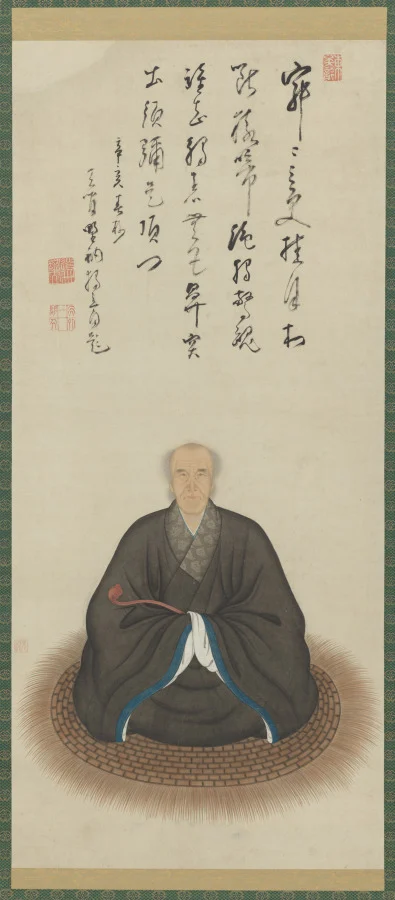
In this portrait, the Ōbaku school Buddhist monk Duli Xingyi (born Tai Li, 1596–1672), whose name is pronounced Dokuryū Shōeki in Japanese, sits upon a woven mat holding a ceremonial scepter known as a <em>ruyi</em>, or <em>nyoi</em> in Japanese. Above his head is an insciption he added to the painting in 1671, the year before his death. It may be translated to read: <br><br>Contemplative emptiness: the moon suspended over the village at midnight. Suddenly my soul is startled by the howl of an ape. Who could know that it would arouse me beyond my senses, and bring me an inner vision from Mt. Sumeru.<br>(translated by Stephen Addiss and Kwan S. Wong) <br><br>Originally from what is now the city of Hangzhou in China, Duli emigrated to Japan in 1653, where he took monastic vows. His skills in calligraphy and seal carving were formidable. Painter Kita Genki combined Chinese brush styles he learned in Nagasaki with Western painting techniques to capture Duli's likeness.
0 observed sales · 0 comparable sales · 2 structured provenance events · 8 structured exhibitions.