Comparable Sales
Same-artist public sales ranked by medium, creation year, dimensions and sale recency.
No public-rights comparable sales meet the current evidence criteria. RELICT does not fill the table with research-only or licensed-only facts.
Observed sale facts, comparable evidence, artist index history and modeled research remain separate.
Same-artist public sales ranked by medium, creation year, dimensions and sale recency.
Count Ottone Ponte di Scarnafigi of Sardinia (died 1788);
Count Louis de Seyssel, (Turin, Italy), sold to Salmon Portland Halle, 1916
Salmon Portland Halle, upon his death, by inheritance to his wife
Mrs. Salmon Portman Halle, by gift to the Cleveland Museum of Art, 1958.
Count Ottone Ponte di Scarnafigi of Sardinia (died 1788); Count Louis de Seyssel, (Turin, Italy), sold to Salmon Portland Halle, 1916 Salmon Portland Halle, upon his death, by inheritance to his wife Mrs. Salmon Portman Halle, by gift to the Cleveland Museum of Art, 1958.
Les Frères Le Nain (The Brothers of Nain). Musée du Louvre, Paris, France (organizer) (October 3, 1978-January 8, 1979). Toledo (Ohio) Museum of Art 1947: "The Brothers Le Nain," cat. no. 14., repr. Paris, Grand Palais, 1978/79: "Les Frères Le Nain," cat. no. 69, pp. 318, 319, 321-322, 324, repr. p. 321. (catalogue by Jacques Thuillier and Michel Laclotte).
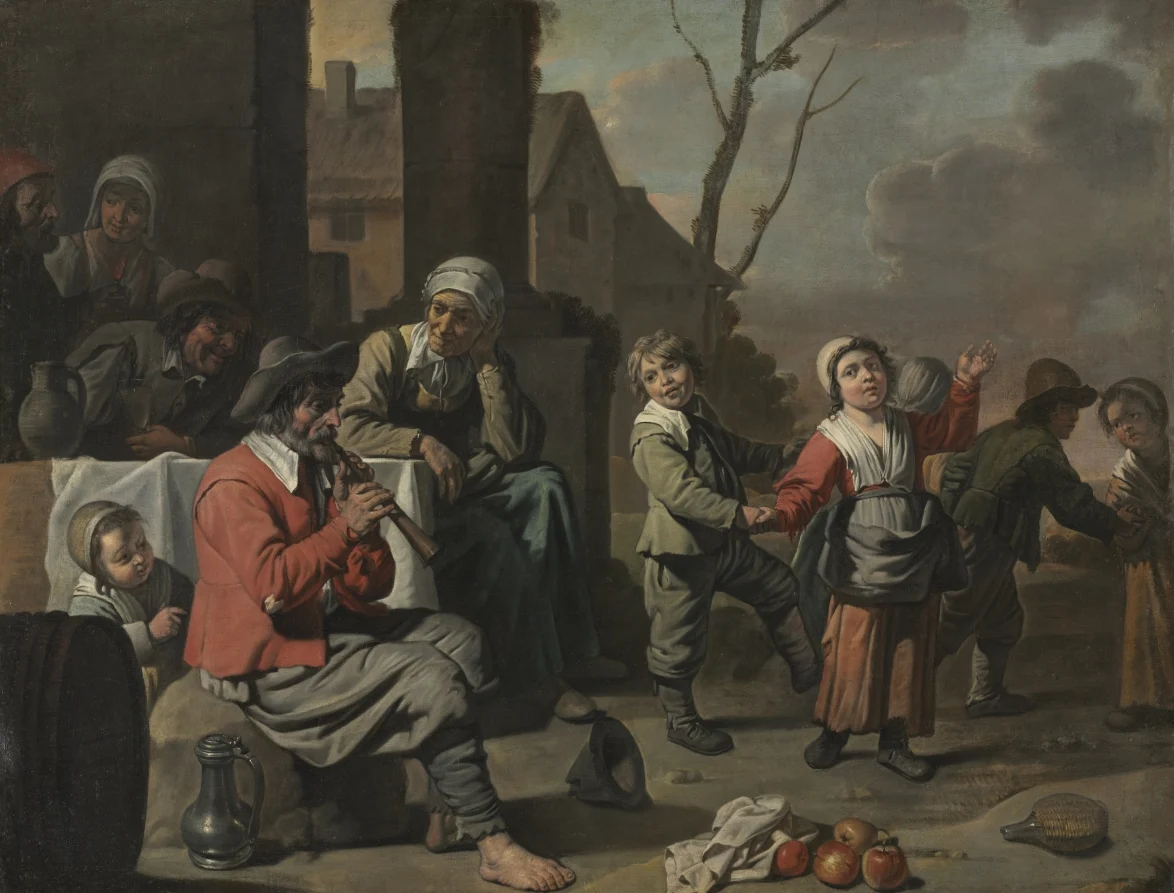
This scene of outdoor, rustic frivolity was probably painted by the Master of the Béguins, a Flemish imitator of the Le Nain brothers who capitalized on their success around the 1650s in Paris. Distinct features of this artist's style are the wide eyes, pudgy cheeks, and white peasant caps—béguins—that give the artist his name. The sturdy and comical peasants, clothed in coarse fabrics with heavy folds, and the use of earthen tones emphasize the provincial mood. During the mid-17th century, the treatment of the poor and lower classes was a subject of great debate in the Catholic Church in Paris, especially at Saint Sulpice, where the Le Nain brothers were buried. Scenes of everyday workers or peasants were incredibly popular, drawing on both comic, Flemish genre scenes of drinking and the French interest in carefully observed, realistic details. Although the picture's meaning remains ambiguous, the gaiety of this world comes from the wonderfully naturalistic details, such as the worn hole on the piper's elbow, the villagers' cheerful expressions, and still-life details such as the ripe apples and reflective drinking vessel.
0 observed sales · 0 comparable sales · 4 structured provenance events · 1 structured exhibitions.