Comparable Sales
Same-artist public sales ranked by medium, creation year, dimensions and sale recency.
No public-rights comparable sales meet the current evidence criteria. RELICT does not fill the table with research-only or licensed-only facts.
Observed sale facts, comparable evidence, artist index history and modeled research remain separate.
Same-artist public sales ranked by medium, creation year, dimensions and sale recency.
Denis-Pierre Papillon de la Ferte
Marius Paulme (sold, Paris, Galerie Georges Petit, November 22, 1923, lots 76 and 77, to Henri Boudo...
1923 - 1949 Henri Boudonneau (Paris, France), by inheritance to his son, Rene Boudonneau, 1949
1949 - 1961 Rene Boudonneau, by inheritance to his wife, Mme S. A. Boudonneau, 1961
1961 - 1974 Mme S. A. Boudonneau (Geneva, Switzerland) (sold, Christie's, London, December 13, 1974...
1974 - 1976 Gallery Cailleux (Paris, France) sold to the Cleveland Museum of Art, 1976.
Denis-Pierre Papillon de la Ferte Marius Paulme (sold, Paris, Galerie Georges Petit, November 22, 1923, lots 76 and 77, to Henri Boudonneau) 1923 - 1949 Henri Boudonneau (Paris, France), by inheritance to his son, Rene Boudonneau, 1949 1949 - 1961 Rene Boudonneau, by inheritance to his wife, Mme S. A. Boudonneau, 1961 1961 - 1974 Mme S. A. Boudonneau (Geneva, Switzerland) (sold, Christie's, London, December 13, 1974, lot 146, to Gallerie Cailleux 1974 - 1976 Gallery Cailleux (Paris, France) sold to the Cleveland Museum of Art, 1976.
Year in Review, 1976. The Cleveland Museum of Art, Cleveland, OH (organizer) (February 1-March 6, 1977).
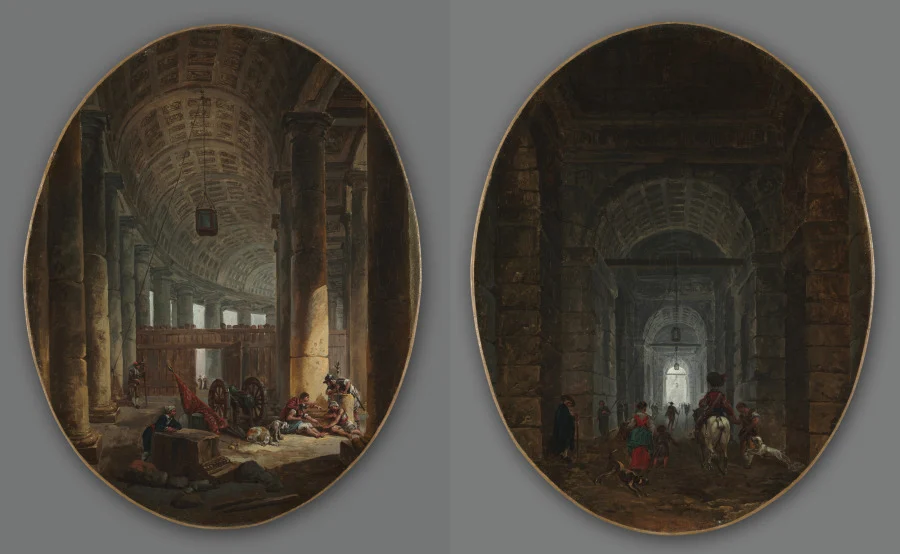
Hubert Robert studied and worked in Italy in 1754–65. Upon returning to Paris, he entered the Royal Academy as an architectural painter and full member in 1766. His time in Italy would prove to be influential and classical architectural subjects would dominate his subsequent work. Interior of the Colonnade of St. Peter's is based on a drawing dated from 1758, the same year that Pope Clement XIII Rezzonico was elected. Given his interest in classical subjects, Robert has antiquated his subject by aging the condition of the columns and including a soldier dressed in ancient Roman armor. Similarly, Robert imaginatively portrays the Grotto of Posillipo. Measuring over 2000 feet in length, this tunnel was carved from volcanic rock by ancient Romans to connect Naples with Pozzuoli. While this passageway was improved by repaving and reinforcing the arches during the reign of Charles III of Naples (1734–59), this structure was never the grand tunnel Robert depicts—with coffered vaults and engaged columns.
0 observed sales · 0 comparable sales · 6 structured provenance events · 1 structured exhibitions.