Comparable Sales
Same-artist public sales ranked by medium, creation year, dimensions and sale recency.
No public-rights comparable sales meet the current evidence criteria. RELICT does not fill the table with research-only or licensed-only facts.
Observed sale facts, comparable evidence, artist index history and modeled research remain separate.
Same-artist public sales ranked by medium, creation year, dimensions and sale recency.
Mizuno, Otsu City, Japan
Dr. Daniel [1921–1996] and Mitzie Verne [1922–2016], Cleveland, OH, given to the Cleveland Museum of...
The Cleveland Museum of Art, Cleveland, OH
Mizuno, Otsu City, Japan Dr. Daniel [1921–1996] and Mitzie Verne [1922–2016], Cleveland, OH, given to the Cleveland Museum of Art The Cleveland Museum of Art, Cleveland, OH
Visions of Japan: Prints and Paintings from Cleveland Collections. The Cleveland Museum of Art, Cleveland, OH (organizer) (December 12, 2004-April 10, 2005). Mingei Museum of World Folk Art, San Diego, CA (June 1985). Emperor Was My Neighbor: Japanese Folk Art from the Collection of Mitzie Verne. Morikami Museum, Delray Beach, FL (March 31-September 15, 2005). Main Asian Rotation (Gallery 236). The Cleveland Museum of Art, Cleveland, OH (July 21, 2014-January 13, 2015).
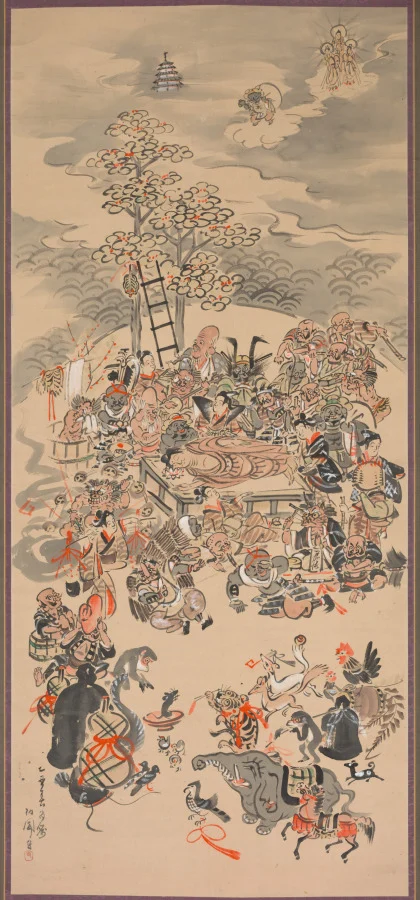
The painting parodies the traditional representation of this subject. The death of Buddha is actually the moment he achieves nirvana and escapes the endless cycle of death and rebirth. Hakuen transformed this serious moment (see <em>The Death of the Buddha</em>, <a href="https://www.clevelandart.org/art/1916.1141"><u>CMA 1916.1141</u></a>) into a lively parody with <em>otsu-e</em> subjects. Mourners surround the Buddha. An <em>oni</em>, who pretends to be a priest, holds his gong in the air as he beats his drums and chants prayers. The wisteria maiden appears at the left, bringing water to the mourners. Behind her is an oni in the guise of a thunder god beating his drums. The animals along the foreground represent other otsu-e characters and models. The painting would have amused 19th-century viewers familiar with the usual Buddhist imagery.
0 observed sales · 0 comparable sales · 3 structured provenance events · 1 structured exhibitions.