Comparable Sales
Same-artist public sales ranked by medium, creation year, dimensions and sale recency.
No public-rights comparable sales meet the current evidence criteria. RELICT does not fill the table with research-only or licensed-only facts.
Observed sale facts, comparable evidence, artist index history and modeled research remain separate.
Same-artist public sales ranked by medium, creation year, dimensions and sale recency.
Maud Eells Corning [1908–1991], Cleveland, OH, bequest to the Cleveland Museum of Art
The Cleveland Museum of Art, Cleveland, OH
Maud Eells Corning [1908–1991], Cleveland, OH, bequest to the Cleveland Museum of Art The Cleveland Museum of Art, Cleveland, OH
Animals in Japanese Art. The Cleveland Museum of Art, Cleveland, OH (organizer) (June 24-December 10, 2023). Main Asian Rotation (Gallery 236). The Cleveland Museum of Art, Cleveland, OH (December 24, 2013-July 21, 2014).
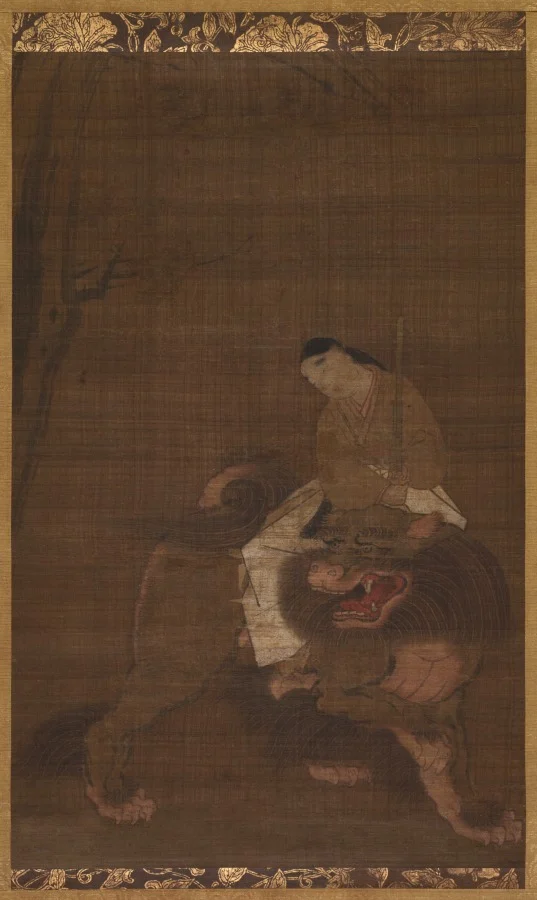
In this work, a young boy dressed in Japanese court costume holds a sword and sacred text, symbols of wisdom carried by the bodhisattva Monju, and rides a lion, also associated with that Buddhist deity. As boy and lion pass beneath a sketchily inked tree, the lion pauses, right foreleg suspended in midair, and the pair looks back. The relatively naturalist posing and sensibility of the painting, as well as the boy’s attire, suggest the possibility that he is a manifestation of a Wakamiya, a youthful <em>kami</em> (a Japanese deity), whose Buddhist counterpart is Monju.
0 observed sales · 0 comparable sales · 2 structured provenance events · 1 structured exhibitions.