Comparable Sales
Same-artist public sales ranked by medium, creation year, dimensions and sale recency.
No public-rights comparable sales meet the current evidence criteria. RELICT does not fill the table with research-only or licensed-only facts.
Observed sale facts, comparable evidence, artist index history and modeled research remain separate.
Same-artist public sales ranked by medium, creation year, dimensions and sale recency.
(Joe Brotherton [1918–2012], San Francisco, CA, sold to the Cleveland Museum of Art)
The Cleveland Museum of Art, Cleveland, OH
(Joe Brotherton [1918–2012], San Francisco, CA, sold to the Cleveland Museum of Art) The Cleveland Museum of Art, Cleveland, OH
Japanese Screens from the Museum and Cleveland Collections. The Cleveland Museum of Art, Cleveland, OH (organizer) (March 23-May 8, 1977). Year in Review: 1977. The Cleveland Museum of Art, Cleveland, OH (organizer) (December 28, 1977-January 22, 1978). Byobu: The Art of the Japanese Screen. The Cleveland Museum of Art (organizer) (August 1-October 14, 1984). Suibokuga: Japanese Ink Painting. The Cleveland Museum of Art, Cleveland, OH (organizer) (October 1, 1985-February 24, 1986). Byobu: The Art of the Japanese Screen. The Cleveland Museum of Art, Cleveland, OH (organizer) (December 8, 1987-January 10, 1988). Asian Autumn: Masterpieces from the Collection. The Cleveland Museum of Art, Cleveland, OH (organizer) (September 17, 1991-January 5, 1992). Asian Autumn: Splendid Variety: 18th-Century Art in Japan. The Cleveland Museum of Art, Cleveland, OH (organizer) (November 16, 1993-March 6, 1994). Highlights of Asian Paintings from The Cleveland Museum of Art. Nara National Museum (organizer) (February 21-March 29, 1998); Suntory Museum of Art (April 28-June 21, 1998). Unfolding Beauty: Japanese Screens from the Cleveland Museum of Art. The Cleveland Museum of Art, Cleveland, OH (organizer) (July 15-September 16, 2001). The Lure of Painted Poetry: Japanese and Korean Art. The Cleveland Museum of Art, Cleveland, OH (organizer) (April 15-August 21, 2011).
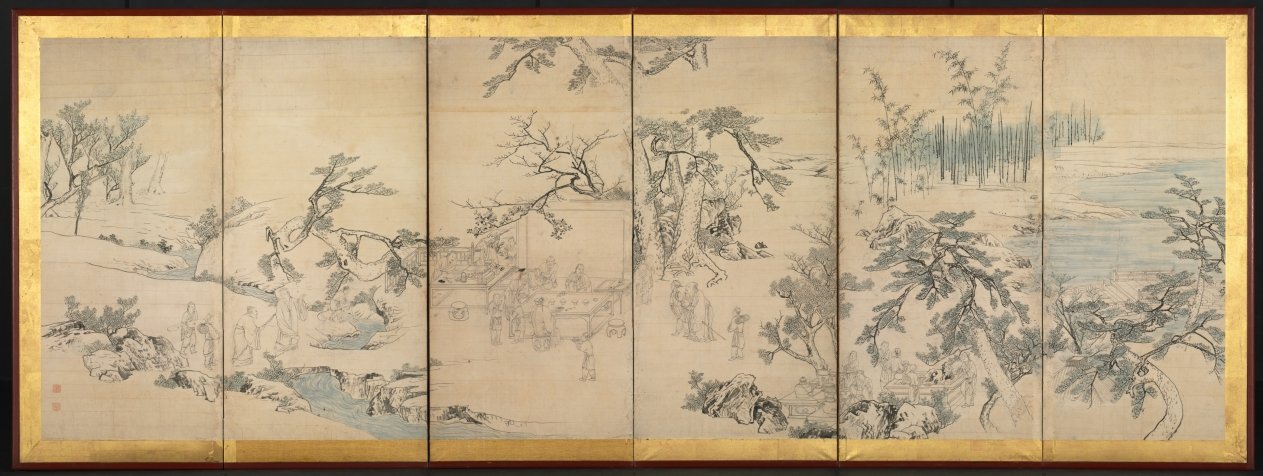
A cheerful gathering of poets was one the most popular themes of East Asian literati paintings. <em>Literary Gathering in the Orchid Pavilion </em>depicts a poets’ party hosted in AD 353 by the famous Chinese calligrapher Wang Xizhi to celebrate the Spring Purification Festival, observed annually on the third day of the third month. Wang invited 41 scholar-poets to compose poetry and drink while seated along the bank of a winding rivulet. This screen would have appeared on the left and shows preparations for the gathering. The lost right screen is assumed to have depicted the poets sitting along the stream.
0 observed sales · 0 comparable sales · 2 structured provenance events · 10 structured exhibitions.