Comparable Sales
Same-artist public sales ranked by medium, creation year, dimensions and sale recency.
No public-rights comparable sales meet the current evidence criteria. RELICT does not fill the table with research-only or licensed-only facts.
Observed sale facts, comparable evidence, artist index history and modeled research remain separate.
Same-artist public sales ranked by medium, creation year, dimensions and sale recency.
- 1785 Count Otto Thott, 1703 - 1785 (Gavnoe Castel, Denmark), upon his death, by inheritance to h...
1785- Heirs of Otto Thott
(London sales 1968)
sold, Christie's, London, July 9, 1976, lot 124, to Noah L. Butkin.
Noah L. Butkin, upon his death, held in trust by the estate.
Estate of Noah L. Butkin, by bequest to the Cleveland Museum of Art, 1980.
- 1785 Count Otto Thott, 1703 - 1785 (Gavnoe Castel, Denmark), upon his death, by inheritance to his heirs 1785- Heirs of Otto Thott (London sales 1968) sold, Christie's, London, July 9, 1976, lot 124, to Noah L. Butkin. Noah L. Butkin, upon his death, held in trust by the estate. Estate of Noah L. Butkin, by bequest to the Cleveland Museum of Art, 1980.
Year in Review: 1980. The Cleveland Museum of Art (organizer) (June 24-July 19, 1981). CMA, 1981, "Year in Review 1980," no. 62.
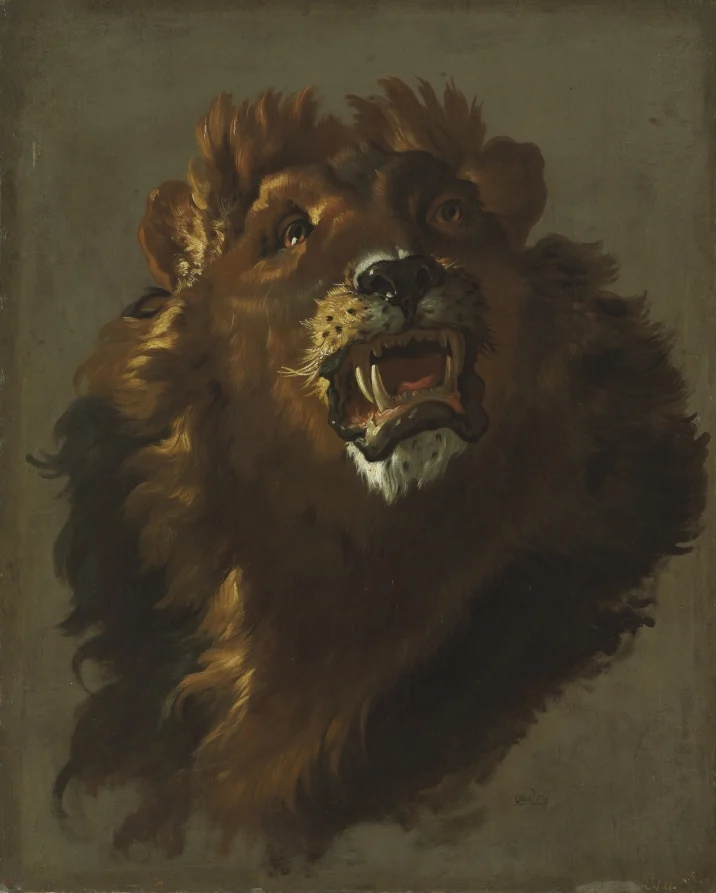
Looking upward with eyes gleaming and mouth open, the lion conveys wild elegance. The sketch comprises short brushstrokes, and its most striking detail is the thick and plentiful mane. Undefined planes of black make up the lion's longest tresses, but closer to the face, the mane becomes increasingly light. Although the darkest parts of the mane lack precise definition, the chestnut shades of the mane host shadows and highlights that lend a sense of realism. Additionally, varied shades of brown are contrasted by the lighter, creamier shades of white at the lion's muzzle. The lifelike nature of this sketch is further communicated by the bright, wet patches on the lion's nose and mouth. Likewise, a bright glimmer in the lion's right eye illustrates its vitality. At the bottom right of the lion, a small signature attributes the painting to the French animal painter Jean-Baptiste Oudry, although this signature was a later addition. This is actually the work of the Italian painter Giuseppe Baldrighi, court artist to the Dukes of Parma. Sent to Paris in 1752, Baldrighi studied with a number of leading French painters, including Oudry, leading to a number of animal studies in Oudry's style. These works emulate the elder artist's smooth handling and stem directly from Oudry's method of executing head studies of animals in expressive poses. This work has a much blunter facture, a more linear use of paint, and a lack of psychological depth in the animal's expression—all characteristic of Baldrighi.
0 observed sales · 0 comparable sales · 6 structured provenance events · 1 structured exhibitions.