Comparable Sales
Same-artist public sales ranked by medium, creation year, dimensions and sale recency.
No public-rights comparable sales meet the current evidence criteria. RELICT does not fill the table with research-only or licensed-only facts.
Observed sale facts, comparable evidence, artist index history and modeled research remain separate.
Same-artist public sales ranked by medium, creation year, dimensions and sale recency.
(Kochukyo Co., Inc., Tokyo, Japan, sold to the Cleveland Museum of Art)
The Cleveland Museum of Art, Cleveland, OH
(Kochukyo Co., Inc., Tokyo, Japan, sold to the Cleveland Museum of Art) The Cleveland Museum of Art, Cleveland, OH
Year in Review, 1976. The Cleveland Museum of Art, Cleveland, OH (organizer) (February 1-March 6, 1977). Japanese Screens from the Museum and Cleveland Collections. The Cleveland Museum of Art, Cleveland, OH (organizer) (March 23-May 8, 1977). Visions of Landscape: East and West. The Cleveland Museum of Art, Cleveland, OH (organizer) (February 17-March 21, 1982). Byobu: The Art of the Japanese Screen. The Cleveland Museum of Art (organizer) (August 1-October 14, 1984). Byobu: The Art of the Japanese Screen. The Cleveland Museum of Art, Cleveland, OH (organizer) (December 8, 1987-January 10, 1988). Unfolding Beauty: Japanese Screens from the Cleveland Museum of Art. The Cleveland Museum of Art, Cleveland, OH (organizer) (July 15-September 16, 2001). Shinto: Discovering the Divine in Japanese Art 神道-日本美術における神性の発見. The Cleveland Museum of Art, Cleveland, OH (organizer) (April 9-June 30, 2019). Main Asian Rotation (Gallery 121).The Cleveland Museum of Art, Cleveland, OH (March 10-July 16, 2003). Main Asian Rotation (Gallery 236). The Cleveland Museum of Art, Cleveland, OH (April 19-December 24, 2013).

Li Anzhong (Chinese, active first half of the 1100s) · 1117
Unknown artist · 1119

John Singleton Copley (American, born The Thirteen Colonies, 1738–1815) · 1760

Meindert Hobbema (Dutch, 1638–1709) · 1657

Frank Duveneck (American, 1848–1919) · 1875
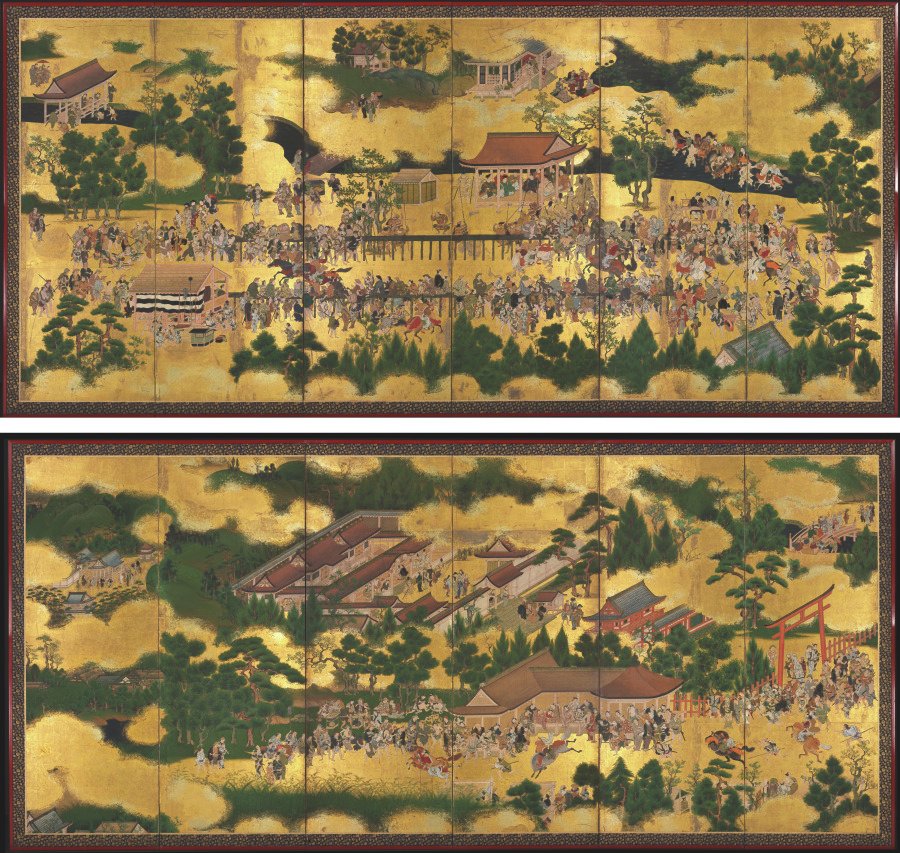
Here nearly 600 figures, engaged in a bewildering array of activities, have gathered at the Kamo Shrine in Kyoto for the horse race held annually on May 5 since at least the 800s. The entire populace seems to have turned out, apparent in the diversions and revelries spread out across these resplendent byøbu. The race begins on the right screen and continues far into the left along the lower half of the composition. Here the painter's genius for depicting engaging crowd scenes, a characteristic of Heian pictorial compositions, emerges in full force. The range of textile patterns alone is astonishing. The upper regions of the composition feature the shrine, its setting in northern Kyoto west of Lake Takaragaike, its architecture, and the visitors whose intentions range from casually mundane to spiritual. These paintings were originally part of a much larger pictorial narrative of linked murals in <em>fusuma-e</em> format. Four segments are known today from what must have been an extraordinary room of contiguous surfaces, executed by studio-trained but anonymous masters of <em>yamato-e</em> genre painting in Kyoto. The scale of the paintings and the quality of the materials indicate that they were commissioned by a sophisticated, wealthy patron.
0 observed sales · 0 comparable sales · 2 structured provenance events · 7 structured exhibitions.