Comparable Sales
Same-artist public sales ranked by medium, creation year, dimensions and sale recency.
No public-rights comparable sales meet the current evidence criteria. RELICT does not fill the table with research-only or licensed-only facts.
Observed sale facts, comparable evidence, artist index history and modeled research remain separate.
Same-artist public sales ranked by medium, creation year, dimensions and sale recency.
(Mathias Komor, New York, NY, sold to Mr. and Mrs. Kelvin Smith)
The Kelvin Smith Collection, Cleveland, OH, given by Mrs. Kelvin [Eleanor Armstrong] Smith [1899–199...
The Cleveland Museum of Art, Cleveland, OH
(Mathias Komor, New York, NY, sold to Mr. and Mrs. Kelvin Smith) The Kelvin Smith Collection, Cleveland, OH, given by Mrs. Kelvin [Eleanor Armstrong] Smith [1899–1998] to the Cleveland Museum of Art The Cleveland Museum of Art, Cleveland, OH
A Private World: Japanese and Chinese Art from the Kelvin Smith Collection. The Cleveland Museum of Art, Cleveland, OH (organizer) (September 14-November 13, 1988). Main Asian Rotation (Gallery 121). The Cleveland Museum of Art, Cleveland, OH (July 13-November 11, 2004).
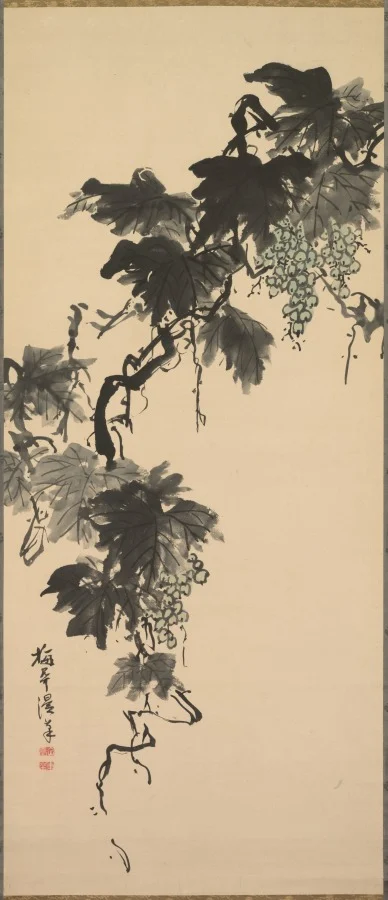
This loose composition is a casual work likely created for an acquaintance by Sugai Baikan, an artist known for his ink landscapes. Baikan was from Sendai in Tōhoku, and painted there before traveling to Edo (Tokyo) and then Kyoto, where he viewed a fan painting by Nagasaki-based Chinese businessman and artist Jiang Jiapu (dates unknown). Inspired, he moved to Nagasaki and studied with Jiang for many years, learning Chinese painting history and techniques. Then, after a stint in Osaka during which he enjoyed wide acclaim in painting and poetry circles, he returned to Sendai. Following a series of natural disasters in the region, his life fell into disarray, and he drowned himself in a well.
0 observed sales · 0 comparable sales · 3 structured provenance events · 1 structured exhibitions.