Comparable Sales
Same-artist public sales ranked by medium, creation year, dimensions and sale recency.
No public-rights comparable sales meet the current evidence criteria. RELICT does not fill the table with research-only or licensed-only facts.
Observed sale facts, comparable evidence, artist index history and modeled research remain separate.
Same-artist public sales ranked by medium, creation year, dimensions and sale recency.
Chen Wenshu 陳文述 [1775–1845], Suzhou, China
Jean-Pierre Dubosc [1904–1988], Paris, France, given to the Cleveland Museum of Art
The Cleveland Museum of Art, Cleveland, OH
Chen Wenshu 陳文述 [1775–1845], Suzhou, China Jean-Pierre Dubosc [1904–1988], Paris, France, given to the Cleveland Museum of Art The Cleveland Museum of Art, Cleveland, OH
Eight Dynasties of Chinese Painting. The Nelson-Atkins Museum of Art (November 7, 1980-January 4, 1981); The Cleveland Museum of Art (February 10-March 29, 1981); Tokyo National Museum (October 4-November 17, 1982).
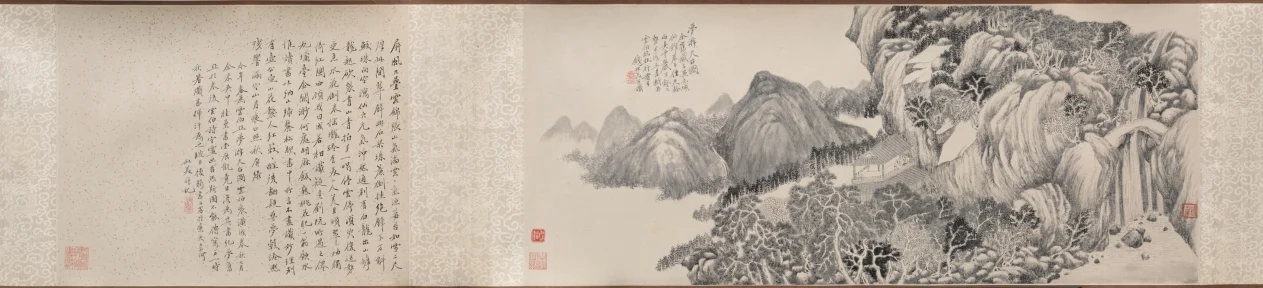
When he painted Mt. Tiantai 天台山, Qian Du was a mature artist with a distinctive style that balanced refinement and “studied awkwardness.” He included the site’s famed features: the crescent-shaped stone bridge arching across the waterfall and surrounded by dense cliffs. Rows of pine and other vegetation appear in the crevices above and below the mountain. The twisting trunks and branches are left in outline, encased within the variegated foliage. In a pavilion at the center, a man and a woman look back to the lower right, across the ravine and toward the cascading water. Beyond and to the left, two simple mounds are backed by hills that stretch into the distance. <br><br>Qian Du left space above the hills for an inscription describing the circumstances that gave rise to the painting. Chen Wenshu, family friend and patron to Qian Du, had dreamt of a journey to Tiantai, a mountain famed for both its natural beauty and its associations with legends and myths. This short handscroll was based on Chen’s description of his dream journey, on which he marveled at the scenery and encountered a goddess. Six months after the painting’s completion, Qian transcribed his friend’s longer poetic reminiscence on paper mounted after the painting. <br><br>The landscape of the painting was not based on the physical site, which likely neither man had visited in 1814, but rather on the mythic tradition of Tiantai. It caused turbulence in the mind of the poet and provided inspiration to the painter.
0 observed sales · 0 comparable sales · 3 structured provenance events · 0 structured exhibitions.