Comparable Sales
Same-artist public sales ranked by medium, creation year, dimensions and sale recency.
No public-rights comparable sales meet the current evidence criteria. RELICT does not fill the table with research-only or licensed-only facts.
Observed sale facts, comparable evidence, artist index history and modeled research remain separate.
Same-artist public sales ranked by medium, creation year, dimensions and sale recency.
H. Mitsui; C. Satomi.
(Howard Hollis and Co., Cleveland, OH, sold to the Cleveland Museum of Art)
The Cleveland Museum of Art, Cleveland, OH, 1959-present
H. Mitsui; C. Satomi. (Howard Hollis and Co., Cleveland, OH, sold to the Cleveland Museum of Art) The Cleveland Museum of Art, Cleveland, OH, 1959-present
Japanese Decorative Style. The Cleveland Museum of Art (August 30-October 15, 1961); The Art Institute of Chicago, Chicago, IL (November 9-December 17, 1961). Japanese Screens from the Museum and Cleveland Collections. The Cleveland Museum of Art, Cleveland, OH (organizer) (March 23-May 8, 1977). Japanese Ink Painting. Tokyo National Museum, Tokyo, Japan (organizer) (October 13-November 23, 1987). Screen Paintings of the Muromachi Period. Tokyo National Museum, Tokyo, Japan (March 28-May 7, 1989). Highlights of Asian Paintings from The Cleveland Museum of Art. Nara National Museum (organizer) (February 21-March 29, 1998); Suntory Museum of Art (April 28-June 21, 1998). Streams and Mountains Without End: Asian Art and the Legacy of Sherman E. Lee at the Cleveland Museum of Art. The Cleveland Museum of Art, Cleveland, OH (organizer) (June 27-August 23, 2009). Admired from Afar: Masterworks of Japanese Painting from the Cleveland Museum of Art. Tokyo National Museum, Tokyo, Japan (January 15-February 23, 2014); Kyushu National Museum, Fukuoka, Japan (July 8-August 31, 2014). Japanese Ink Paintings from American Collections: The Muromachi period: An exhibition in honor of Shūjirō Shimada. The Art Museum, Princeton University, Princeton, NJ (April 25–June 13, 1976).
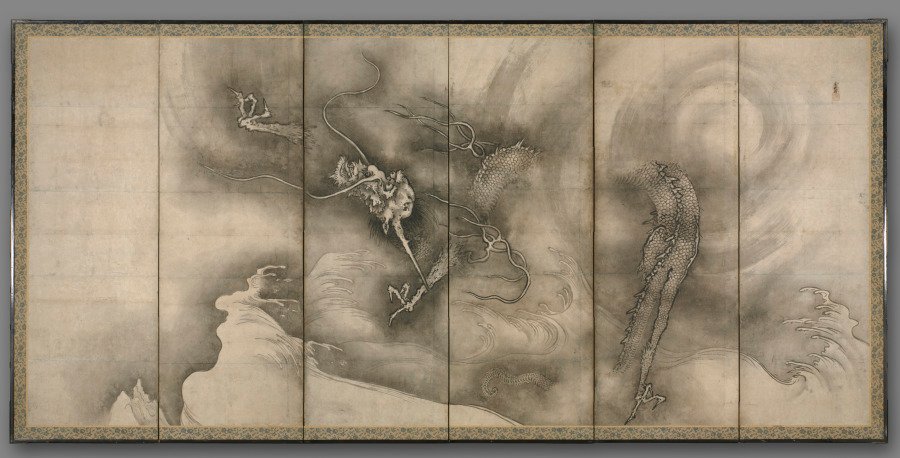
In Chinese cosmology, dragons produce rain clouds. The dragon disappearing into and reemerging from clouds in this painting seems to generate rough waves in the water below, pulling it toward the sky. The shape of the foreground wave is indirectly sampled from a painting by 13th-century Chinese painter Yujian, a handscroll once owned by the Ashikaga military rulers of Japan. Sesson must have known the famous painting though copies, and made a copy of his own. Here, the wave reinforces the powerful quality of the dragon.
0 observed sales · 0 comparable sales · 3 structured provenance events · 7 structured exhibitions.