Comparable Sales
Same-artist public sales ranked by medium, creation year, dimensions and sale recency.
No public-rights comparable sales meet the current evidence criteria. RELICT does not fill the table with research-only or licensed-only facts.
Observed sale facts, comparable evidence, artist index history and modeled research remain separate.
Same-artist public sales ranked by medium, creation year, dimensions and sale recency.
Miner K. Kellogg
Mrs. Liberty E. Holden, Cleveland
Holden Collection
Miner K. Kellogg; Mrs. Liberty E. Holden, Cleveland. Holden Collection, 1916.
Miner K. Kellogg Mrs. Liberty E. Holden, Cleveland Holden Collection Miner K. Kellogg; Mrs. Liberty E. Holden, Cleveland. Holden Collection, 1916.
Inaugural Exhibition. The Cleveland Museum of Art, Cleveland, OH (organizer) (co-organizer) (June 6-September 20, 1916). The Twentieth Anniversary Exhibition: The Official Art Exhibit of the Great Lakes Exposition. The Cleveland Museum of Art, Cleveland, OH (organizer) (June 26-October 4, 1936). Cleveland, 1894: "Cleveland Art Loan Exhibition," Held in the Hickox Building, cat. no. 12.
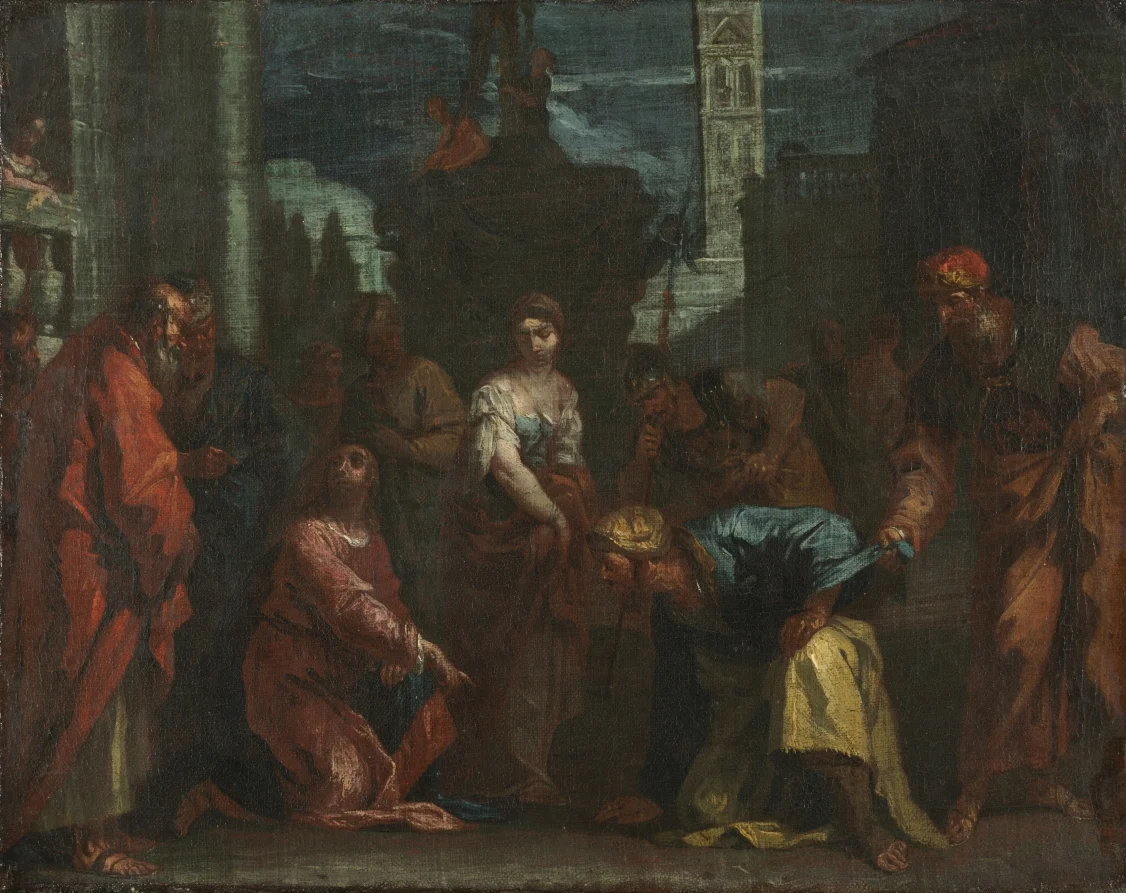
The subject originates in the Gospel of John 7:53-8:11, where Pharisees bring a woman accused of adultery to Christ, attempting to trick him into disobeying the Old Testament precept that she be stoned. In response, Christ interrupted his writing on the ground, stating: "Let anyone among you who is without sin be the first to throw a stone at her." The Pharisees, unable to retort, gradually disperse, and Christ eventually sends the woman away with an admonition not to sin again. The subject was popular in 18th-century Venice, partly because magnanimity was an important value, celebrated in visual, musical, and literary culture. The showy, exotic subject and the public presentation of an openly sexualized woman also enjoyed popularity in 18th-century Venetian painting. This work is a copy of the picture at the Minneapolis Institute of Arts, perhaps by a student (and certainly not by Ricci himself)
0 observed sales · 0 comparable sales · 4 structured provenance events · 2 structured exhibitions.