Comparable Sales
Same-artist public sales ranked by medium, creation year, dimensions and sale recency.
No public-rights comparable sales meet the current evidence criteria. RELICT does not fill the table with research-only or licensed-only facts.
Observed sale facts, comparable evidence, artist index history and modeled research remain separate.
Same-artist public sales ranked by medium, creation year, dimensions and sale recency.
Count Ottone Ponte di Scarnafigi of Sardinia (died 1788);
Count Louis de Seyssel, Turin, sold to Salmon P. Halle, 1916
Salmon P. Halle, upon his death, by inheritance to his wife.
Mrs. Salmon P. Halle, by gift to the Cleveland Museum of Art, 1957.
Count Ottone Ponte di Scarnafigi of Sardinia (died 1788); Count Louis de Seyssel, Turin, sold to Salmon P. Halle, 1916 Salmon P. Halle, upon his death, by inheritance to his wife. Mrs. Salmon P. Halle, by gift to the Cleveland Museum of Art, 1957.
La Peinture Francaise dans les Collections Americaines. Musée des Beaux-Arts de Bordeaux, F-33000 Bordeaux, France (organizer) (May 13-September 15, 1966). Les Frères Le Nain (The Brothers of Nain). Musée du Louvre, Paris, France (organizer) (October 3, 1978-January 8, 1979). Object Lessons: Cleveland Creates an Art Museum. The Cleveland Museum of Art, Cleveland, OH (organizer) (June 7-September 8, 1991). The Triumph of French Painting: Seventeenth Century Masterpieces from the Museums of FRAME [FRAME]. Portland Art Museum, Portland, OR (organizer) (October 11, 2003-January 4, 2004); Birmingham Museum of Art, Birmingham, AL (January 25-April 11, 2004); Meadows Museum (April 30-July 25, 2004). CMA, 1934: "Art of the Seventeenth and Eighteenth Centuries," no catalogue. Toledo (Ohio) Museum of Art, 1947: "The Brothers Le Nain," cat. no. 13, repr. Musée de Bordeax, France, May-September 1966: "La Peinture française dans les collections américaines," cat. no. 9, plate 11. Paris, Grand Palais, 1978/79: "Les Frères Le Nain," cat. no. 53, pp. 216, 254, 266-67, repr. (Catalogue by Jacques thuillier and michel Laclotte). CMA, June 7-September 8, 1991: "Object Lessons: Cleveland Creates an Art Museum." Portland Art Museum, OR (10/11/2003 - 1/4/2004), Birmingham Museum of Art (1/25/2004 - 4/11/2004) and Meadows Museum, Southern Methodist University, Dallas (5/2/2004 - 7/25/2004): "The Triumph of French Painting: 17th Century Masterpieces from the Museums of FRAME", p. 70-71.
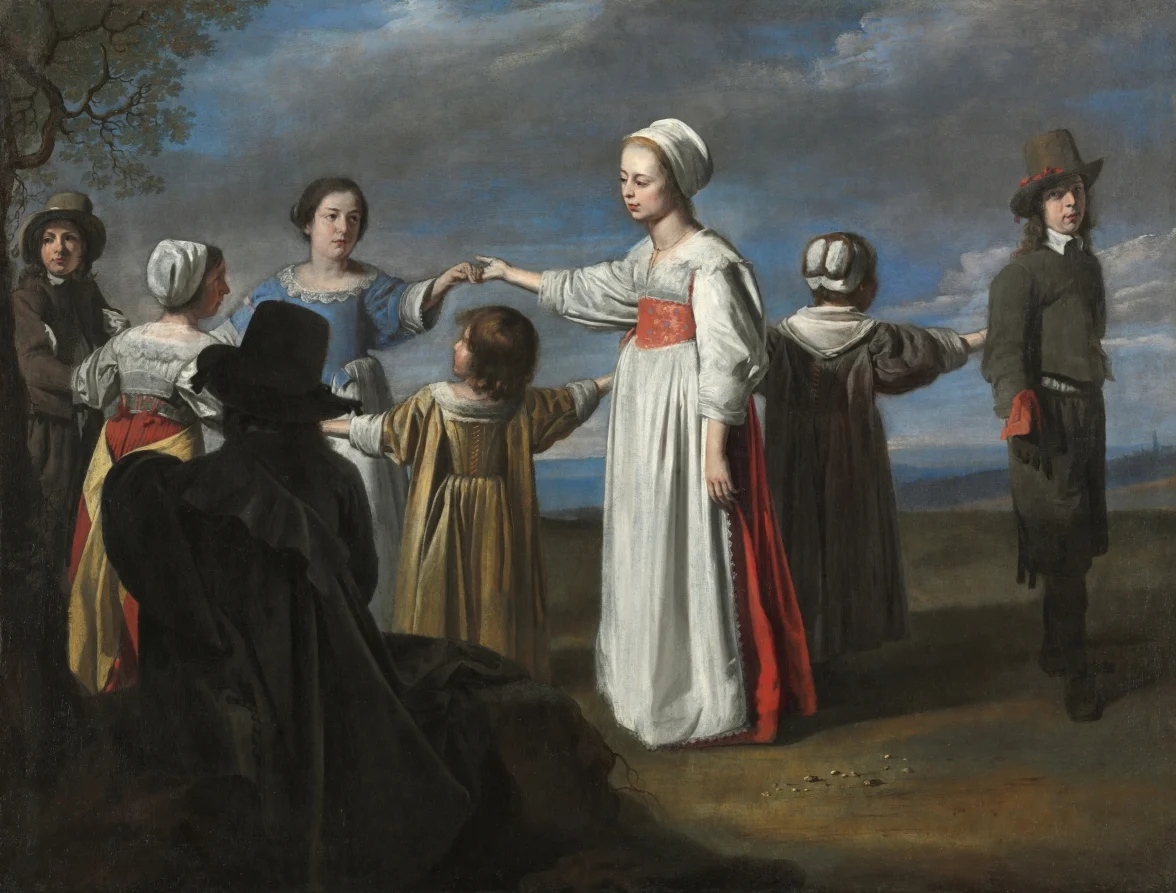
Antoine, Louis, and Mathieu Le Nain were brothers who ran a collective studio in Paris from around 1630 until 1648, when Antoine and Louis died. Mathieu continued to produce work under their name "Le Nain" throughout the 1650s. Of the museum's four paintings that have been called "Le Nain" (1958.174, 1958.175.1, 1958.175.2), this work has held its attribution to Mathieu the longest. With his back to the viewer, a musician sits in shadow while a group of children pose patiently in a chain-like formation, awaiting the start of their dance. Because of its reliance on order and collaboration, dancing symbolized familial harmony. The attention to the individuality of the children suggest a family portrait, while their wistful expressions and melancholic tone have led to the hypothesis that the children are portraits-both living and posthumous. The description of the intricate lace and the wearied expressions of the slim boys is characteristic of Mathieu's handling. However, the canvas has been attributed to one of Mathieu's followers, the Master of the Games, because of the static, brightly lit figures whose elongated shadows don't quite describe their forms.
0 observed sales · 0 comparable sales · 4 structured provenance events · 4 structured exhibitions.