Comparable Sales
Same-artist public sales ranked by medium, creation year, dimensions and sale recency.
No public-rights comparable sales meet the current evidence criteria. RELICT does not fill the table with research-only or licensed-only facts.
Observed sale facts, comparable evidence, artist index history and modeled research remain separate.
Same-artist public sales ranked by medium, creation year, dimensions and sale recency.
George Gund III [1937-2013], bequest to the Cleveland Museum of Art
The Cleveland Museum of Art, Cleveland, OH
George Gund III [1937-2013], bequest to the Cleveland Museum of Art The Cleveland Museum of Art, Cleveland, OH
Ink Paintings and Ash-Glazed Ceramics: Medieval Calligraphy, Painting, and Ceramic Art from Japan and Korea. The Cleveland Museum of Art, Cleveland, OH (organizer) (March 19-May 28, 2000). Japanese Gallery 235 Rotation. The Cleveland Museum of Art (organizer) (January 2-July 9, 2018).
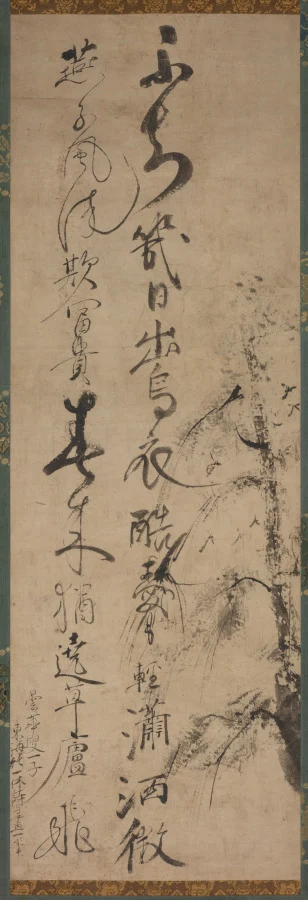
The famed Buddhist monk Ikkyū is best remembered for his calligraphy. Calligraphic conventions of his time called for brushwork that did not vary much in style from character to character. However, as Ikkyū’s lines progress, his brushwork wanders between standard script and a sort of shorthand, marked by an uneven distribution of ink and a reduction of the characters to only the most necessary strokes. Ikkyū’s direct communication of emotion via brushwork became characteristic of the works produced by monks affiliated with the temple Daitokuji later in the Edo period (1615–1868).
0 observed sales · 0 comparable sales · 2 structured provenance events · 2 structured exhibitions.