Comparable Sales
Same-artist public sales ranked by medium, creation year, dimensions and sale recency.
No public-rights comparable sales meet the current evidence criteria. RELICT does not fill the table with research-only or licensed-only facts.
Observed sale facts, comparable evidence, artist index history and modeled research remain separate.
Same-artist public sales ranked by medium, creation year, dimensions and sale recency.
(Heisando Co., Ltd., Tokyo, Japan, sold to the Cleveland Museum of Art)
(Heisando Co., Ltd., Tokyo, Japan, sold to the Cleveland Museum of Art)
The Year in Review for 1988. The Cleveland Museum of Art, Cleveland, OH (organizer) (March 1-May 14, 1989). Asian Autumn: Masterpieces from the Collection. The Cleveland Museum of Art, Cleveland, OH (organizer) (September 17, 1991-January 5, 1992).
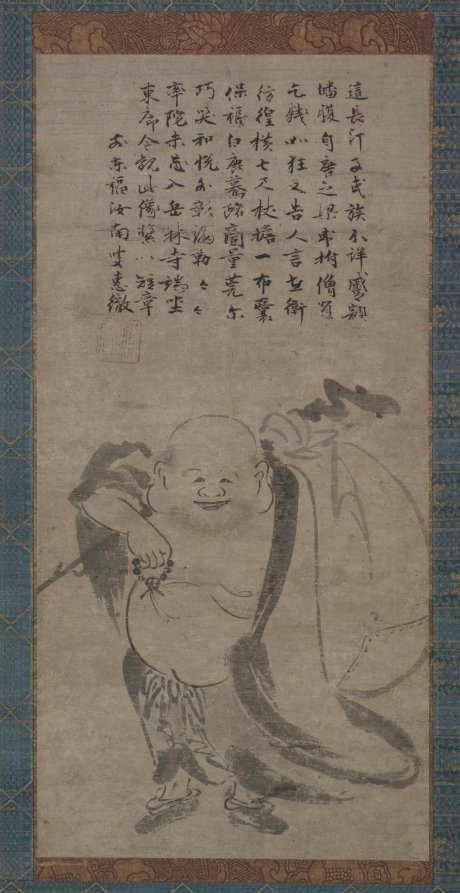
The Zen monk Jonan Etetsu is recorded as the 183rd abbot of Tō fuku-ji temple in the eastern hills of Kyoto, one of the earliest and most influential Zen institutions in medieval Japan. Otherwise, the only biographical information known to date has been gleaned from a few inscriptions on paintings documenting his friendship with another eminent monk, Ryō ’an Keigo (1425–1514), and two paintings bearing Jonan’s own poetic inscriptions. This image of Hotei (Chinese: Budai), a legendary, 10th-century Chan (Zen) monk, is one of those paintings. In Japan the image of the mirthful, pot-bellied Hotei enjoyed great popularity from the 14th century onward. Zen literature and popular folklore merged to create a storehouse of attractive fiction concerning this delightful character’s worldly adventures as a kind of itinerant Santa Claus and more symbolically as the future Buddha, Miroku, in disguise. For the Japanese, Hotei came to represent an unfettered path to spiritual enlightenment. The identity of the artist of this painting is unknown, although it may have been Etetsu, who attained a high rank within the 15th-century Zen community.
0 observed sales · 0 comparable sales · 1 structured provenance events · 2 structured exhibitions.