Comparable Sales
Same-artist public sales ranked by medium, creation year, dimensions and sale recency.
No public-rights comparable sales meet the current evidence criteria. RELICT does not fill the table with research-only or licensed-only facts.
Observed sale facts, comparable evidence, artist index history and modeled research remain separate.
Same-artist public sales ranked by medium, creation year, dimensions and sale recency.
(Wells Objects of Art, Inc., New York, NY, sold to the Cleveland Museum of Art)
The Cleveland Museum of Art, Cleveland, OH
(Wells Objects of Art, Inc., New York, NY, sold to the Cleveland Museum of Art) The Cleveland Museum of Art, Cleveland, OH
East Indian Art. The Detroit Institute of Arts, Detroit, MI (organizer) (February 10-March 29, 1942). Art and Stories from Mughal India. The Cleveland Museum of Art, Cleveland, OH (organizer) (July 31-October 23, 2016). Indian Miniature Rotation (Gallery 115). The Cleveland Museum of Art, Cleveland, OH (August 13, 2003-February 18, 2004). Indian Miniature Rotation (Gallery 115). The Cleveland Museum of Art, Cleveland, OH (August 18, 2004-May 23, 2005). Main Asian Rotation (Gallery 245). The Cleveland Museum of Art, Cleveland, OH (July 2, 2014-January 5, 2015). Boston, Museum of Fine Arts, Sport in Art: From American Collections Assembled for an Olympic Year (15 November-15 December, 1955); traveled to Washington, D. C., Corcoran Gallery of Art, (5-30 January, 1956); to Louisville, J. B. Speed Art Museum, (14 February-10 March, 1956); to Dallas, Dallas Museum of Fine Arts (25 March-20 April, 1956); to Denver, Denver Art Museum (5-30 May, 1956); San Francisco, California Palace of the Legion of Honor, (28 July-26 August 1956); intended for Melbourne, Australia, Olympic Games, but this stop was cancelled.
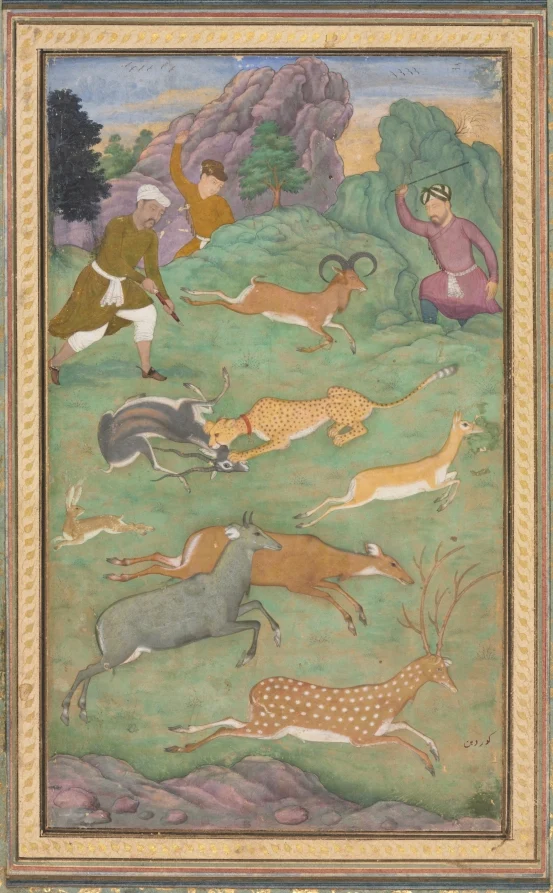
The Mughals used trained cheetahs, such as this one wearing a red collar, to capture prey during hunting expeditions in the wilderness. The metaphor of the hunt was also a potent image in Persian literature, in which the protagonist finally achieves a desired goal. The central image of the cheetah catching the black buck—a frequently repeated visual trope—resonates with the desire of Prince Salim (who was passionate about hunting) to capture the throne of the Mughal Empire from Akbar, his father. Between 1600 and 1605, when Prince Salim set up his own royal court in defiance of his father, he convinced some imperial artists to join him. The young Govardhan, a Hindu who would go on to achieve high stature in the atelier of the next two emperors, was one of them.
0 observed sales · 0 comparable sales · 2 structured provenance events · 2 structured exhibitions.